

Website Design & Development Cost in Delhi: 2026 Pricing Guide
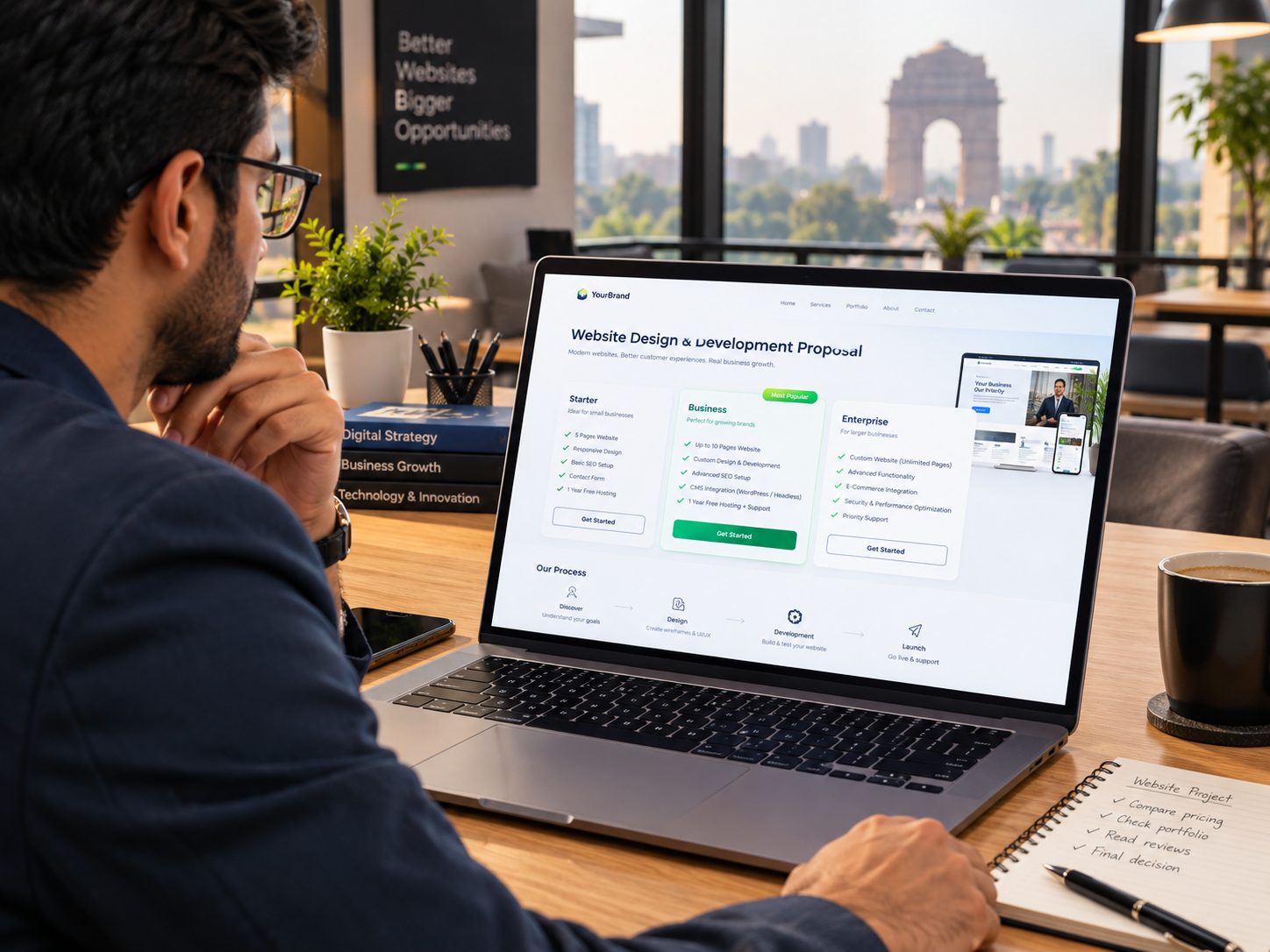
How Much Does Website Design & Development Cost in Delhi in 2026?
Quick answer: A basic business website in Delhi may start around ₹12,000 - ₹25,000, while a professionally designed business website commonly falls in the ₹35,000 - ₹80,000 range. Ecommerce platforms, booking systems, and custom web applications can cost considerably more - often ₹1,50,000 upward depending on scope. These are indicative project ranges, not fixed market rates.
Website design and development costs in Delhi can range from around ₹12,000 for a simple business website to several lakhs for ecommerce platforms and custom web applications. The right budget depends less on the number of pages alone and more on the design, functionality, integrations, technology, content and support your project requires.
What moves a project up or down within those ranges? Mainly: whether the design is custom or template-based, which technology is used, what functionality is needed (forms, payments, bookings, user accounts), whether content creation is included, and how experienced the developer or agency is.
The sections below break all of this down so you can interpret quotes, understand what you're actually getting, and avoid common pitfalls on both ends of the price spectrum.
Website Development Cost in Delhi at a Glance
The table below shows indicative price ranges for common website types built in Delhi. These are illustrative estimates based on typical project scope - actual quotes will vary based on your specific requirements.
Website Type | Indicative Price Range | Typical Use Case |
|---|---|---|
Basic business website | ₹12,000 – ₹25,000 | Local businesses, consultants, simple brochure sites |
Professional business website | ₹35,000 – ₹80,000 | Growing businesses needing polished design and CMS |
Custom business website | ₹80,000 – ₹1,50,000 | Unique design, custom functionality, multiple integrations |
Ecommerce website | ₹60,000 – ₹2,50,000+ | Online stores; product volume and features drive cost |
Booking / appointment website | ₹70,000 – ₹2,00,000+ | Clinics, salons, service businesses, coaching |
Portfolio website | ₹15,000 – ₹45,000 | Freelancers, designers, photographers, agencies |
Blog / content website | ₹20,000 – ₹60,000 | Content businesses, influencers, media |
Custom web application | ₹1,50,000 – ₹5,00,000+ | SaaS products, platforms, complex workflows |
Note: These are not official market averages. They reflect realistic project budgets based on typical scope. Your actual cost depends on what you need built.
Website Cost by Type
Basic Business Website
This typically covers five to seven pages: Home, About, Services, Contact, and perhaps a Blog listing. Design is usually template-based or minimally customized, built on WordPress or a similar CMS. It includes a contact form, basic responsive design, and straightforward deployment.
Suitable for: Local retailers, individual consultants, small service providers, or anyone who needs an online presence without complex functionality.
What raises the price: More pages, a custom design, specific animations, additional integrations (WhatsApp chat, maps, calendars), or adding a blog with category filtering.
Professional Business Website
This is where most serious small and mid-size Delhi businesses should be looking. A professional site includes a properly structured custom or semi-custom design, mobile-optimized pages, a working CMS that your team can actually manage, well-structured service pages, a contact/inquiry form, basic on-page SEO architecture, and tested performance across devices.
Suitable for: Professional services firms, B2B companies, healthcare providers, education businesses, real estate agencies, and any business where the website needs to make a strong first impression and generate inquiries.
What raises the price: Multiple service lines, a large number of pages, multilingual content, custom UI design, additional sections like testimonials feeds, case study portfolios, or team directories.
Custom Business Website
Custom here means the design is built from scratch - no template, no pre-made theme. Custom development typically involves specific functionality that can't be handled by standard plugins, unique user flows, or a backend built to match the business's exact processes.
Suitable for: Businesses with specific requirements that off-the-shelf solutions can't meet, or where the brand requires a genuinely distinctive web presence.
Ecommerce Website
The price range on ecommerce is particularly wide because "an online store" can mean anything from 20 products with basic checkout to a 5,000-SKU catalogue with inventory management, multiple payment gateways, shipping integration, order tracking, and customer accounts.
A small WooCommerce or Shopify-based store with 50–100 products can be built in the ₹60,000–₹1,20,000 range. A custom-built ecommerce platform with advanced filtering, loyalty programs, and ERP integration is a fundamentally different project.
What raises the price: Number of products, custom product pages, multiple payment gateway integrations, GST invoicing, shipping rate calculators, inventory management, return/refund workflows, customer dashboards.
Booking / Appointment Website
Common for clinics, salons, coaching businesses, home services, and restaurants. The baseline includes a calendar-based booking system, service selection, time slots, and usually some form of confirmation email or SMS. More complex versions involve practitioner-specific calendars, online payment at booking, rescheduling workflows, and CRM integration.
This category overlaps with custom web applications once you start adding workflow complexity.
Portfolio Website
Generally simpler in backend but design-intensive on the frontend. Photographers, interior designers, architects, and creative agencies need a site where the work speaks for itself. The cost reflects design quality and the effort required to present visuals well across devices.
Blog / Content Website
The development cost here is usually moderate, but the real investment is content. A blog built on WordPress with a good theme and proper category/tagging structure is not an expensive build. What drives ongoing investment is content production, SEO, and traffic.
Custom Web Application
This is development, not just website work. A custom SaaS product, a multi-vendor marketplace, an internal tool, a booking platform with vendor management - these involve proper software architecture, database design, user authentication, admin dashboards, and often API development.
If your project involves user roles, data processing, automated logic, or third-party API integrations beyond standard plugins, you're in web application territory and should budget accordingly.
What Is Included in Website Design & Development?
This question matters more than most people realize, because two quotes at different prices may include completely different things. Here is what professional website development should typically include:
Usually included:
- UI/UX design (custom or template-based, depending on scope)
- Responsive design (desktop, tablet, and mobile)
- Frontend development (HTML, CSS, JavaScript)
- Backend development where needed (CMS, custom logic)
- Content Management System (so you can update content yourself)
- Contact / inquiry form
- Basic on-page SEO structure (meta tags, headings, clean URLs, sitemap)
- Image optimization and basic performance setup
- Google Analytics or Search Console connection
- SSL setup or guidance
- Cross-browser testing
- Deployment to your hosting
Commonly charged separately:
- Copywriting and content creation
- Photography and video
- Logo design and branding
- Premium plugins or third-party tools
- Domain name and hosting
- Ongoing SEO
- Post-launch content updates
- Feature additions after launch
Always ask for a written scope of work that lists what is and is not included. A quote without a scope attached is not a quote - it's an estimate for something undefined.
What Affects Website Development Cost in Delhi?
A restaurant that only needs its menu, location, contact details and a WhatsApp button has very different requirements from a restaurant that wants table reservations, online ordering, customer accounts and payment processing. Both might be described as "a business website for a restaurant" - but they are not the same project.
Here are the main factors that move a project's cost:
Pages and content volume. More pages mean more design work, more development, and more content. A 30-page website is not six times the work of a 5-page site, but it's substantially more.
Custom vs template design. A template speeds things up significantly. A fully custom design - where every component is conceived and built from scratch - takes considerably more time and skill.
CMS complexity. A basic WordPress CMS is inexpensive to set up. A custom content management system built in Laravel with specific fields, workflows, and admin interfaces is a different conversation.
Ecommerce features. Product pages, checkout, payments, inventory management, orders, and customer accounts each add development scope.
Booking systems. Calendar logic, availability management, time slots, staff allocation, and confirmation flows are non-trivial to build properly.
Payment gateways. Integrating Razorpay, PayU, PayTM, or Stripe is usually straightforward, but multi-currency support, subscription billing, or split payments add complexity.
Third-party integrations. CRM integrations, ERP connections, WhatsApp Business API, email marketing tools, mapping APIs, and similar services require development time and occasionally licensing costs.
User accounts and dashboards. Anywhere users can register, log in, and manage their data means authentication systems, role management, and secure data handling.
Multilingual content. Adding Hindi or regional language support is doable but adds design, development, and content scope.
Animations and microinteractions. Tasteful motion design can elevate a website's feel but adds development time.
Performance requirements. A website expected to handle high traffic or requiring sub-second load times on every connection needs extra optimization work.
Content creation. If you're providing all copy and images, your cost is lower. If you need the developer or agency to write content, source photography, or produce video, that's additional budget.
Freelancer vs Website Development Company in Delhi: Which Costs More?
Freelancers are typically less expensive than agencies, sometimes significantly so. A capable freelance developer in Delhi might charge ₹15,000–₹60,000 for a project that an agency quotes at ₹50,000–₹1,50,000. That gap exists for real reasons.
Agencies offer:
- A team - separate people for design, development, and project management
- Structured delivery process with milestones and reviews
- Broader accountability (a business with a reputation to protect)
- Usually better capacity for parallel tasks (design and development simultaneously)
- Post-launch support contracts
Freelancers offer:
- Lower overhead, which usually means lower prices
- Direct communication with the person doing the work
- Flexibility and faster decisions
- Good value for focused, well-scoped projects
The honest take: A single skilled freelancer can build an excellent website, often better than a mid-tier agency with a fixed process. The risk with freelancers is project management, availability, and what happens after launch - a freelancer who becomes unavailable leaves you without support.
For a simple five-page website or a portfolio, a good freelancer is often the right choice. For a complex ecommerce build, a booking platform, or a project where ongoing support is critical, an agency with a defined maintenance offering generally makes more sense.
What you should avoid is making the decision purely on price. A ₹12,000 quote from a freelancer for a project that genuinely requires ₹60,000 of work is not a bargain - it's a project that won't be completed properly or will come back to you half-finished.
WordPress vs Custom Website Development: Which Should You Choose?
There's no universal answer here - the right technology depends on what you're building, how you'll manage it, and where you expect to take it.
Factor | WordPress | Laravel (Custom) | Next.js | HTML/CSS/JS |
|---|---|---|---|---|
Development speed | Fast | Moderate–Slow | Moderate | Fast (simple sites) |
Ongoing cost | Plugins can add up | Lower ongoing licensing | Lower ongoing licensing | Minimal |
Customization ceiling | Moderate (plugins limit you) | Very high | Very high | Limited (no backend) |
CMS ease of use | Excellent | Depends on build | Depends on build | Requires separate CMS |
Security | More attack surface (popular target) | Better control | Better control | Minimal (no backend) |
Scalability | Moderate | High | High | Low |
Best for | Blogs, brochure sites, small ecommerce | Complex apps, SaaS, custom workflows | Performance-critical sites, modern frontend | Simple landing pages |
WordPress makes sense when: you need a site quickly, you want to manage content easily without developer involvement, you're running a blog or content site, or your ecommerce needs are well served by WooCommerce.
Custom development (Laravel, Next.js) makes sense when: your project has specific functionality that plugins can't handle well, you're building something with complex data relationships, you need tight control over performance and security, or you're building a SaaS product or web application.
The pitfall to avoid: Using WordPress for something it wasn't designed for, then spending the next two years fighting plugin conflicts, performance issues, and security patches. Equally, paying for a full custom build when a well-configured WordPress site would serve you perfectly well for three years.
Delhi-Specific Considerations
Delhi and the NCR region have a wide range of web development needs that don't always get addressed in generic pricing articles.
Local service businesses - salons, clinics, home services, tutors - often need something between a basic brochure site and a proper booking platform. A physiotherapy clinic in South Delhi needs appointment booking, service descriptions, and probably a Google Maps integration more than it needs a flashy custom design.
Real estate businesses in Delhi NCR frequently need property listing pages with search filters, location-based browsing, and inquiry forms per property. This is more complex than a standard business site and is worth scoping properly.
Restaurants in Delhi that want online ordering or table reservations need a proper system - not a static menu page. If you're going to invest in the tech, invest in something that actually functions.
Professional services firms (lawyers, CAs, consultants) in Delhi generally need a site that builds credibility quickly: clear service pages, a team section, case studies or client testimonials, and a well-designed inquiry process. The design matters here even if the functionality is simple.
Startups and D2C brands need to think about scalability from the start. Building on a platform you'll outgrow in 18 months is a common and expensive mistake.
One practical point: if being able to walk into an office matters to you, working with a Delhi-based agency gives you that. If you're comfortable working entirely online, you expand your options considerably - many excellent developers across India work remotely with no difference in output quality.
Additional Website Costs You Should Budget For
The quote you receive for website development usually covers development only. These are the additional costs that catch people off guard:
Domain name: Indicative range ₹800–₹2,000+/year for a .com or .in domain, varying by registrar and domain extension. A one-time setup expense, then annual renewal.
Hosting: Indicative range ₹3,000–₹30,000+/year depending on the type and provider. Shared hosting works for simple sites; VPS or managed hosting is typically needed for higher-traffic or ecommerce sites.
SSL certificate: Often included with hosting plans now, but confirm this before signing up. Without SSL, your site shows a "Not Secure" warning in browsers.
Email hosting: Professional email (you@yourcompany.com) varies by provider and plan - Google Workspace, for example, has its own pricing tiers. Budget separately for this rather than assuming it's included in hosting.
Premium plugins or themes: If your site uses premium WordPress tools, these typically carry annual licensing fees that vary by product. Check the renewal cost before committing to any plugin-dependent build.
Copywriting: Rates vary widely by writer experience and content depth. Get a separate quote for content if you need it written professionally.
Photography: Professional product or team photography in Delhi varies considerably by photographer, session length, and deliverables. Get a dedicated quote based on your requirements.
Logo and branding: If you don't have a logo, budget for professional design separately. Costs vary based on whether you work with a freelance designer or a branding studio.
Payment gateway fees: Razorpay, PayU, and similar gateways each publish their transaction fee structures, which change over time - check the current rates directly with the provider. Not a development cost, but an ongoing business cost per transaction.
GST: If your developer or agency is GST registered, 18% GST applies to the development cost. Confirm their GST status upfront.
Why Are Some Websites in Delhi So Cheap?
You'll find quotes in Delhi for complete websites at ₹5,000–₹10,000. It's worth understanding what that usually means before comparing it to a ₹60,000 quote.
A very low-cost website typically involves one or more of the following:
- A pre-built template installed with your content and logo dropped in - no actual design work
- Minimal revisions (sometimes none after the first draft)
- No custom functionality - whatever the template does is what you get
- Client-supplied content and images (you write everything, they put it in)
- Shared hosting on a crowded server
- No proper testing across devices or browsers
- Minimal or no SEO structure
- No post-launch support
None of this is inherently dishonest. If a small local business genuinely needs a basic online presence and understands they're getting a template-based site with no custom work, ₹8,000 may be entirely appropriate.
The problem arises when someone expects a custom-designed, professionally developed, SEO-structured, well-performing website and gets a template install instead - or when the cheap site creates problems (slow loading, security issues, plugin conflicts) that cost more to fix than the original development.
A website is not a product you buy once. It's something your business will use for two to five years. The meaningful comparison is not just the upfront price but what the site will do for your business over that period.
How to Compare Website Development Quotes
When you receive quotes from multiple developers or agencies, the price difference is often because they're quoting different things. Use this checklist to make sure you're comparing like with like.
Confirm the quote covers:
- [ ] Exact number of pages included
- [ ] Whether design is custom or template-based
- [ ] Number of design revisions
- [ ] Mobile responsiveness
- [ ] Which CMS or technology will be used
- [ ] Whether you can manage content yourself after launch
- [ ] Contact forms and basic integrations
- [ ] Basic on-page SEO structure (meta tags, sitemap, headings)
- [ ] Image optimization and performance basics
- [ ] Testing across devices and browsers
- [ ] Deployment to your hosting
- [ ] Who provides domain and hosting (and at what cost)
- [ ] How many rounds of content revisions are included
- [ ] Who owns the website files and source code after delivery
- [ ] What post-launch support is included and for how long
- [ ] What happens when you want new features or pages later
If any of these are unclear, ask before accepting the quote. Ambiguity here is how projects go over budget or under-deliver.
10 Questions to Ask Before Hiring a Website Development Company in Delhi
1. What exactly is included in this price?
Get a written scope. "Website development" means different things to different people. You want a page list, a feature list, and confirmation of what's excluded.
2. Is the design custom or template-based?
Both are legitimate. Know which you're getting. A custom design takes more time and costs more; a template can still look professional. The problem is paying custom rates for template work.
3. Who owns the website and source code after delivery?
You should own both. Some developers retain rights to the code or lock your site into proprietary platforms. Confirm you'll receive all files and database access.
4. What CMS or technology will be used?
Ask why. WordPress is not always the right choice. Neither is a fully custom build for a simple brochure site. The technology should match the requirements.
5. Is basic SEO included?
Ask specifically whether they'll configure meta titles, meta descriptions, heading structure, XML sitemaps, and clean URL structure. This takes a few hours and makes a meaningful difference to how Google reads your site.
6. How many revisions are included?
Unlimited revisions doesn't mean what it sounds like. Get a clear number of design revisions and content change rounds in writing.
7. What happens after launch?
This is where many projects fall apart. Who fixes bugs? Who updates plugins? What does post-launch support cost? Get a clear answer on what happens in the 30-90 days after you go live.
8. What are the recurring costs?
Hosting, domain, email, plugin licenses, maintenance - ask for an estimate of annual costs beyond the one-time development fee so you can budget properly.
9. How is website security handled?
For WordPress sites: which security measures are included, how are plugin updates managed, and are backups set up? For custom sites: how is user input sanitized, how are dependencies managed?
10. What happens if I want new features later?
Can they handle future development? What's their typical rate for hourly or project-based work after launch? Knowing this upfront saves surprises when you need to add something six months later.
How Much Does Website Maintenance Cost in Delhi?
Most websites need some level of ongoing maintenance. Here's what typical maintenance involves and what it costs:
Basic maintenance (₹2,000–₹5,000/month): Plugin and CMS updates, security patches, uptime monitoring, monthly backups, and a small allocation for minor fixes.
Standard maintenance (₹5,000–₹15,000/month): Everything above plus regular content updates (changing service details, adding blog posts, updating team pages), performance checks, and priority bug fixing.
Growth / SEO maintenance (₹15,000–₹50,000+/month): Technical maintenance combined with active SEO - keyword targeting, content publishing, link building, local SEO, and monthly reporting.
Ad hoc maintenance (per hour or per task): Some businesses prefer not to pay a monthly retainer and instead pay for changes as needed. Indicative developer rates in Delhi for maintenance work can range from ₹500–₹2,500/hour depending on skill level and complexity, though this varies significantly by developer.
For platforms that require regular updates, security patches, backups, or content changes - WordPress in particular - ongoing maintenance is an important part of keeping the website secure and reliable. An unupdated WordPress site is one of the most common sources of website hacks. If you're on WordPress, budget for at minimum plugin and CMS updates, even if you handle everything else yourself.
Does Website Development Include SEO?
This distinction matters when you're comparing quotes. Website development and SEO are not the same thing, even though they overlap.
What website development typically includes (technical SEO foundation):
- Clean, crawlable URL structure
- Proper heading hierarchy (H1, H2, H3)
- Meta title and description fields (so you can fill them in)
- XML sitemap generation
- Robots.txt configuration
- Responsive design (a ranking factor)
- Page speed optimization
- Structured data / schema markup (in better builds)
- Google Search Console submission
What it doesn't include:
- Keyword research
- Content written to target specific search queries
- Link building
- Local SEO (Google Business Profile optimization, local citations)
- Ongoing monitoring and optimization
- Monthly reporting
A developer who builds you a technically clean website is giving you the foundation for SEO. Achieving rankings requires ongoing content and link work on top of that foundation. These are separate services with separate costs.
If a developer tells you that SEO is "included" in their website package, ask exactly what that means. Often it means they'll set up meta tags - which is the right answer for development scope. If they're promising rankings, that's a different conversation.
FAQ
How much does a website cost in Delhi in 2026?
Indicative ranges: ₹12,000–₹25,000 for a basic business site, ₹35,000–₹80,000 for a professional business site, ₹60,000–₹2,50,000+ for ecommerce, and ₹1,50,000+ for custom web applications. Actual cost depends on your specific requirements.
What is a reasonable budget for a 5-page business website?
A professionally built five-page website with custom design, mobile responsiveness, a CMS, contact form, and basic SEO setup typically runs ₹30,000–₹60,000 in Delhi. Template-based builds can be done for less; fully custom designs cost more.
How much does an ecommerce website cost in Delhi?
A straightforward online store with up to 100 products, a payment gateway, and basic order management is typically ₹60,000–₹1,20,000. Larger catalogues, custom product pages, multiple gateways, inventory integration, or a custom platform push costs considerably higher.
Is WordPress cheaper than custom development?
Usually yes, upfront. WordPress sites are faster to build because much functionality is handled by existing plugins. The trade-off is flexibility ceiling and long-term plugin management. Custom Laravel or Next.js development costs more initially but gives you more control and often lower ongoing licensing costs.
How long does website development take?
A basic business website: 2–4 weeks. A professional business website with custom design: 4–8 weeks. Ecommerce: 6–12 weeks. Custom web applications: 3–6 months or more. Timelines slip most often because of late content delivery from the client, scope changes mid-project, or revision cycles.
Should I hire a freelancer or a web development agency?
For a simple, well-scoped project with a clear brief, a skilled freelancer is often the better value. For complex builds, ongoing support requirements, or projects where you need a team to work in parallel, an agency structure is more reliable. Don't choose based on price alone.
What should be included in a website quotation?
Page list, design scope (custom or template), revision rounds, CMS, mobile responsiveness, forms, integrations, basic SEO setup, testing, deployment, source code ownership, and post-launch support. Any quote missing these specifics needs clarification before you accept it.
Do I need to pay for hosting separately?
Usually yes. Most website development quotes cover the cost of building the site, not running it. Budget separately for domain, hosting, and email hosting - the actual figures depend on the provider and plan you choose. Ask your developer which hosting environment they'd recommend for your project and get a current quote from the provider directly.
What does website maintenance cost?
Basic maintenance (updates, backups, minor fixes) runs ₹2,000–₹8,000/month. Standard maintenance with content updates is ₹5,000–₹15,000/month. SEO-focused ongoing work starts at ₹15,000/month.
Does my website development include SEO?
A good development build includes technical SEO foundations - clean URLs, meta tags, sitemaps, responsive design, and performance basics. It does not typically include keyword research, content strategy, link building, or local SEO. Those are ongoing services with separate scope and pricing.
What happens if I don't maintain my website?
For WordPress and other plugin-dependent platforms, outdated software is one of the most common entry points for attacks. Beyond security, unupdated sites can develop compatibility issues, slow down, or break when hosting environments update. The more your site relies on third-party plugins or a CMS, the more important regular maintenance becomes.
What's the most common mistake Delhi businesses make when buying a website?
Two things: choosing a developer based on price alone without checking the scope, and failing to plan for content. The cheapest quote rarely reflects the full project, and a well-built website with no useful content will not generate leads.
Getting a Website Built in Delhi: Where to Start
If you're trying to understand what your project will actually cost, the most useful thing you can do is get a scoped estimate rather than a ballpark number. The difference between a ₹30,000 and a ₹1,20,000 quote for your website is almost always in the details of what's being built - not arbitrary pricing differences between developers.
SmarterDigi provides website design and development services for businesses in Delhi and across India. If you're at the stage of figuring out what you need and what it might cost, we're happy to walk through your requirements and give you an honest project estimate - no pressure, no guesswork.
The Author
Meraj Ahmad
Founder, developer, and SEO strategist with 10+ years of experience building websites and digital solutions. Worked with brands like Short Story Lovers, The Muthoot Group, and IFFCO.