
Google Ads vs SEO for Indian Businesses: The Honest Answer in 2026
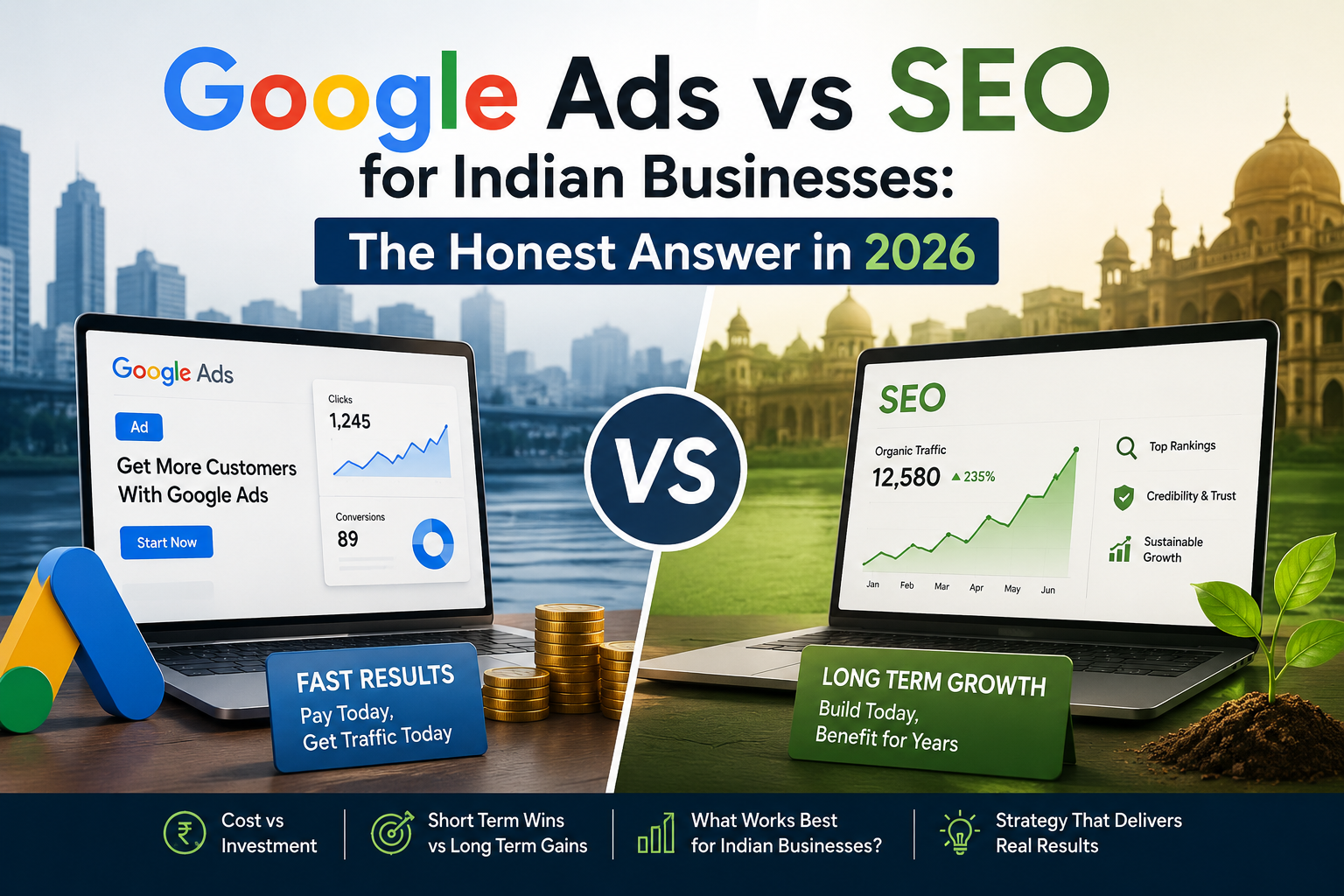
Every Indian small business owner reaches this question eventually. You need more customers. You have a limited budget. And two people are telling you two completely different things - one says run Google Ads for immediate results, the other says invest in SEO for long-term growth.
Both are right. Both are also incomplete.
The question is not "Google Ads or SEO?" The correct question is "which one should I prioritise at my current stage - and when do I use both?"
Get this sequence wrong and you either burn your budget on ads before your website can convert them, or you wait 9 months for organic traffic while a competitor captures every lead in your market.
This guide gives you the honest, data-backed answer for Indian small businesses specifically - with real cost figures, realistic timelines, and a clear decision framework based on your situation.
The Quick Answer: Google Ads or SEO?
Before going deeper, here is the simplest way to decide:
Your situation | Prioritise |
|---|---|
| You need leads immediately | Google Ads |
| You have a brand-new website | Google Ads + SEO |
| You have a limited long-term budget | SEO |
| You have a seasonal promotion or time-sensitive offer | Google Ads |
| You run a local service business | Local SEO + Google Business Profile |
| You operate in a highly competitive market | SEO + Google Ads |
| You want long-term organic traffic | SEO |
| You need to test an offer or message quickly | Google Ads |
| You have ₹30,000+ per month for marketing | Usually both |
The important point is that this does not have to be a permanent choice. Google Ads can provide immediate visibility while SEO builds an asset that becomes more valuable over time.
What Each One Actually Does
Before comparing them, it helps to be precise about what Google Ads and SEO actually are - because most comparisons blur the distinction.
Google Ads (Paid Search)
Google Ads places your business at the top of search results for the keywords you bid on. You pay every time someone clicks your ad - hence the term Pay Per Click (PPC). Your ad appears immediately after your campaign goes live. Stop paying and the traffic generated by those ads stops almost immediately.
The key characteristics:
- Immediate visibility - live within hours of setting up
- Fully controllable - you choose keywords, budget, geography, and schedule
- Pay per click - every visitor costs money, with no residual value
- No compounding - year two costs exactly as much as year one for the same traffic volume
- Clearly marked as ads - Google labels paid results, and some users consciously skip them
SEO (Search Engine Optimisation)
SEO improves your website's position in Google's organic (non-paid) results. You invest time and money building content, earning backlinks, and optimising technical performance - and Google rewards this with rankings that bring unpaid clicks. Results take months to appear. Once established, rankings can continue working without per-click cost.
The key characteristics:
- Delayed visibility - typically several months before significant traffic arrives
- Compounding value - a page that ranks in month six can keep producing traffic in month eighteen
- No per-click cost - once ranking, traffic does not incur a direct click charge
- Higher trust - many users perceive organic results as more credible than advertisements, particularly when researching professional services
- Builds an owned asset - SEO authority, content, and rankings are associated with your domain
These are fundamentally different tools. Comparing them on a single dimension - speed, or cost, or volume - misses the point. The right question is which tool serves your current needs.
The Real Cost of Google Ads in India in 2026
Google Ads costs in India are frequently misunderstood. Business owners hear "digital advertising" and assume it is cheap. It can be - or it can be significantly more expensive than expected, depending on your category and competition level.
Published 2026 India benchmarks show that CPC can vary widely, from relatively low-cost local searches to several hundred rupees for highly competitive commercial keywords. There is no single CPC that accurately represents every Indian business.
Here is a realistic breakdown by category for Indian small businesses in 2026:
| Category | Indicative CPC Range | Indicative Monthly Budget |
|---|---|---|
| Local services (plumbing, cleaning) | ₹15 – ₹50 | ₹10,000 – ₹20,000 |
| Healthcare and clinics | ₹30 – ₹100 | ₹20,000 – ₹40,000 |
| Web design and digital services | ₹50 – ₹300 | ₹20,000 – ₹50,000 |
| Education and coaching | ₹40 – ₹150 | ₹15,000 – ₹40,000 |
| Real estate | ₹100 – ₹500 | ₹50,000 – ₹3,00,000 |
| Finance and lending | ₹80 – ₹250 | ₹30,000 – ₹5,00,000 |
These are indicative market ranges rather than fixed Google prices. Actual CPC depends on keyword competition, search intent, location, device, ad quality, bidding strategy, and other auction factors.
These are ad spend figures - separate from agency management fees (typically ₹10,000 – ₹25,000/month) and the cost of the landing pages required to convert the traffic.
The minimum effective Google Ads budget for most Indian small businesses - enough to generate meaningful data and consistent leads - is often around ₹15,000 to ₹30,000 per month in ad spend. The appropriate amount depends heavily on your CPC, target geography, conversion rate, and lead value.
For a local service business in a single city, ₹30,000 to ₹75,000 per month can be a realistic starting media budget in competitive markets, but smaller campaigns can also make sense when CPCs are lower or the service has a high customer value.
The Real Cost of SEO in India in 2026
SEO has two cost components: the website foundation (built once) and the ongoing optimisation and content work (recurring).
Website SEO foundation (one-time): A properly built website with SEO architecture built in - correct URL structure, metadata, schema markup, Core Web Vitals optimisation, Google Search Console setup - is the essential starting point. This is included in a professionally built website. If your existing site lacks this foundation, retrofitting it costs ₹20,000 to ₹60,000 depending on its current state.
Ongoing SEO (monthly): SEO retainer pricing in India varies considerably depending on competition and scope. Published 2026 pricing guides commonly place local and small-business SEO in the ₹10,000–₹40,000+ monthly range, with competitive national campaigns costing considerably more. For most Indian small businesses targeting a single city with moderate competition, a budget of ₹15,000 to ₹25,000 per month can be a realistic starting point for a focused SEO program, provided the scope is appropriately limited.
The critical difference from Google Ads: SEO spend in month one can continue producing value in month twelve. Google Ads spend in month one produces value only while the campaign generates paid traffic.
The ROI gap over time: There is no single reliable India-wide ROI percentage for SEO or Google Ads. Results vary dramatically based on industry, customer value, conversion rate, competition, attribution, and execution quality. SEO can become more cost-efficient as rankings and content compound, while Google Ads provides a more immediate but ongoing cost for each click.
Speed: The Most Important Difference
This is where most Indian business owners make the wrong decision. They hear "SEO takes 6 months" and choose Google Ads for speed - without considering what that means for their total cost structure at month 12, 24, and 36.
Google Ads timeline:
- Day 1: Campaign live, ads appearing
- Week 1–2: Initial data, optimise targeting and bids
- Month 1: Consistent traffic, first leads arriving
- Month 6: Same cost per click as month one - no compounding
- Month 12: Same cost per click as month one - still no compounding
- If you stop: Traffic generated by the ads stops almost immediately
SEO timeline:
Most businesses need several months before meaningful organic traffic develops. Lower-competition local keywords can move faster, while new websites and highly competitive markets can take considerably longer.
- Month 1–2: Technical setup, keyword research, content creation begins
- Month 3–4: First rankings appear for lower-competition keywords
- Month 6–9: Meaningful organic traffic arriving, leads beginning
- Month 12: Consistent lead flow may begin developing, depending on competition and execution
- Month 18: Rankings from month 6 can still produce traffic without a per-click charge
- If you stop monthly spend: Traffic can continue from established rankings, although rankings and performance may decline over time if the site becomes outdated or competitors continue investing
The speed advantage of Google Ads is real but temporary. The compounding advantage of SEO is slow to start but can grow over time.
Lead Quality: Which Brings Better Customers?
This is a nuance most comparisons skip - and it matters significantly for Indian service businesses.
Google Ads lead quality considerations:
Google Ads targets keywords, not intent stages. A user searching "website design India" could be a business owner ready to hire today, a student doing research, or a competitor checking your ads. You pay for the click regardless of whether the visitor ultimately becomes a customer.
Additionally, users increasingly recognise Google Ads as paid placements and some consciously skip them.
Ad fatigue is also real. In competitive categories where multiple businesses are running similar ads, users can become desensitised to paid listings and look specifically for organic results they perceive as more objective.
SEO lead quality considerations:
Many users trust organic results more than advertisements. Businesses ranking naturally through SEO can appear more credible - especially important in India where users increasingly research businesses carefully before purchasing services.
A visitor who finds your website through organic search has typically spent more time researching. They have read your content, seen your expertise demonstrated, and arrived with a higher level of pre-formed trust. This can translate to higher close rates and higher average order values compared to some cold ad traffic, although actual results depend on the business and sales process.
The practical implication: for Indian service businesses where trust is a critical purchase factor - consultants, healthcare providers, legal services, premium home services, professional agencies - SEO can be particularly valuable because it supports the research phase before a customer contacts you.
The 3-Year Cost Comparison: What the Math Actually Shows
Let us run an illustrative scenario for a typical Indian small business - a web design agency in Delhi targeting local service clients.
These figures are a planning example, not a universal forecast. Actual CPCs, management costs, conversion rates, customer values, and SEO results vary significantly between businesses.
Google Ads only (₹20,000/month ad spend + ₹12,000/month management):
- Monthly total: ₹32,000
- Year 1 total: ₹3,84,000
- Year 2 total: ₹3,84,000 before any changes in CPC or management fees
- Year 3 total: approximately ₹4,20,000 if costs rise
- Illustrative 3-year total: approximately ₹11,88,000
- Assets owned at end of year 3: The business still owns its website, account, data, and landing-page assets, but paid search traffic itself stops when the ad spend stops
SEO only (₹20,000/month for a proper program):
- Year 1: ₹2,40,000 (slow start, meaningful traffic from month 6)
- Year 2: ₹2,40,000 (potential compounding - same spend, potentially more traffic)
- Year 3: ₹2,40,000 (established rankings, assuming continued performance)
- Illustrative 3-year total: ₹7,20,000
- Assets owned at end of year 3: Content, technical improvements, backlinks, established rankings, and other SEO assets that can continue producing traffic even if monthly spend is later reduced
Combined strategy (₹15,000 ads + ₹15,000 SEO monthly):
- Monthly total: ₹30,000
- Year 1: Ads cover immediate lead needs while SEO builds foundation
- Year 2: SEO rankings can reduce dependency on ads - shift some ad budget to new keywords
- Year 3: SEO can produce a larger share of leads - ads fill gaps and target competitive terms
- Illustrative 3-year total: ₹10,80,000 - with a compounding owned asset at the end
The combined strategy can cost less than an equivalent ads-only plan in some scenarios while building an asset that can reduce customer acquisition costs over time. The actual result depends on campaign performance, SEO execution, conversion rate, and customer lifetime value.
The Critical Factor Indian Businesses Miss: Your Website Must Convert
This is the mistake that makes Google Ads expensive for Indian small businesses - running ads to a website that was not built to convert them.
Consider the math using a simple formula:
Leads = Ad Spend ÷ Average CPC × Conversion Rate
For example, if you spend ₹20,000/month and your average CPC is ₹50, you receive approximately 400 clicks.
- At a 1% conversion rate: approximately 4 leads
- At a 2% conversion rate: approximately 8 leads
- At a 3% conversion rate: approximately 12 leads
- At a 4% conversion rate: approximately 16 leads
The difference is not necessarily the ads. It can be the website and landing-page experience.
This is why 10 website mistakes that cost Indian businesses leads must be fixed before meaningful ad spend begins. Running Google Ads to a website with no clear value proposition, no trust signals, no mobile optimisation, and no strong CTAs is burning money to send qualified traffic to a broken sales process.
Before increasing any ad budget, run your site through this question: if 100 interested visitors land on your homepage today, how many will contact you? If the honest answer is fewer than three, fix the website first. Every rupee you spend on ads before that fix is a fraction of what it should be returning.
Our guide on professional websites for small businesses in India covers exactly what a conversion-ready website includes.
The New Factor in 2026: AI Search and GEO
Both Google Ads and SEO are being reshaped by the rise of AI-powered search - and Indian businesses need to understand this before allocating budget.
Google AI Overviews now appear on a growing portion of searches, providing AI-generated answers above or alongside traditional search results. Recent research indicates that AI-generated search experiences can change click behaviour and reduce some outbound clicks, although the impact varies by query and search experience.
The implication is significant: both SEO and Google Ads are competing for attention in an increasingly complex search results page as AI-generated answers absorb more queries without necessarily generating a traditional website visit.
This is why Generative Engine Optimisation (GEO) - structuring your content so AI-powered search systems can understand, evaluate, and potentially cite it - is becoming increasingly important alongside traditional SEO.
A business that is clearly represented in AI-generated answers for searches such as "website design company Delhi" can gain visibility before a customer even clicks a traditional organic result.
The businesses investing in GEO-optimised content now - structured, factual, directly answering the questions Indian customers search - can build an additional visibility advantage alongside their traditional SEO efforts.
The Decision Framework: Which One Is Right for Your Business Right Now?
Stop thinking about this as a permanent choice. Think about it as a sequencing decision based on your current situation.
Prioritise Google Ads if:
You have just launched your website. A brand new domain may need several months to build enough authority to rank meaningfully in competitive local searches. During this period, Google Ads provides immediate visibility while your SEO foundation develops. Use ads as a bridge - not necessarily a permanent strategy.
You have a time-sensitive opportunity. A seasonal product, a promotional offer, a new service launch - Google Ads lets you capitalise on specific windows without waiting for organic rankings to develop.
You are in a highly competitive category. In markets like real estate, finance, and education where competitors may have years of SEO authority, Google Ads can help you compete immediately for high-intent keywords while your organic presence develops.
You need to test messaging and positioning quickly. Google Ads gives you data on which headlines, offers, and value propositions generate clicks and conversions - in weeks rather than months. This data can then inform your SEO content strategy.
Prioritise SEO if:
You have a limited long-term budget. If ₹15,000 to ₹25,000 per month is your total digital marketing budget, SEO can deliver stronger long-term economics than putting the entire budget into paid clicks, particularly when your market has achievable organic opportunities.
You are targeting local service keywords. For searches like "interior designer in Delhi" or "CA firm in Bangalore," local SEO combined with a fully optimised Google Business Profile can be highly effective - and does not require paying for every click. Our complete guide to local SEO for small businesses in India covers this in full detail.
You are building a long-term business. If your goal is market dominance in your category and city over the next 3 to 5 years, SEO is the foundation. The businesses that dominate Indian local search in 2028 are the ones investing in content and authority today.
Your customer journey involves research. For high-consideration purchases - business services, professional services, home renovation, healthcare - customers research extensively before contacting. Appearing in organic results during this research phase builds trust before the customer even knows they are considering you.
Use Both When:
You have a budget that supports it. The most effective strategy for many Indian small businesses with a budget of ₹30,000 or more per month is a combination: Google Ads for immediate lead flow while SEO builds the long-term foundation. As SEO rankings improve, you can reduce your Google Ads budget on keywords where you now rank organically - and shift that budget to new keywords or other channels.
You want to reduce long-term ad dependency. As your SEO rankings mature, systematically reduce Google Ads spend on keywords where you now rank organically. Reinvest that budget in SEO content or new ad campaigns targeting keywords you have not yet ranked for organically. Over time, your cost per acquired customer can fall even as your lead volume grows.
What Indian Businesses Should Do Before Running Any Ads
Regardless of whether you choose Google Ads, SEO, or both - these three things must be in place first. Running any paid or organic strategy without them wastes significant budget.
1. A conversion-optimised website. Your website must convert visitors into leads before you drive traffic to it. This means a clear value proposition above the fold, mobile-first design that loads in under 3 seconds, prominent WhatsApp and contact CTAs, trust signals including testimonials and GST number, and Google Analytics tracking. Without this, every click - paid or organic - underperforms what it should deliver.
2. A fully optimised Google Business Profile. For local searches - which account for a significant share of Indian service business queries - your Google Business Profile is often more valuable than Google Ads. It is free, it powers your appearance in Google Maps, and it requires no per-click spend. Before spending a rupee on ads, complete every field on your GBP and start building reviews systematically.
3. Basic SEO foundations on your website. Correct page titles, meta descriptions, URL structure, and schema markup are the minimum technical foundation. For Google Ads specifically, your landing page should also be highly relevant to the ad and keyword, easy to navigate, mobile-friendly, and aligned with the user's expectations. Google states that landing page experience is one of the components used in its Quality Score diagnostic, alongside expected CTR and ad relevance. A relevant, useful landing page can therefore support stronger ad quality and performance.
To understand what a website investment looks like in India before committing to ongoing ad spend, read our guide on how much a small business website costs in India.
Key Takeaways
- Google Ads delivers immediate traffic but no compounding value from the paid clicks themselves - stop paying and the ad-generated traffic stops
- SEO takes several months to produce meaningful results but can compound over time - a page that ranks in month 6 can continue producing traffic in month 18
- There is no single reliable SEO or Google Ads ROI percentage for all Indian businesses; actual returns depend on CPC, conversion rate, customer value, competition, attribution, and execution
- Google Ads cost per click in India can range from relatively low-cost local searches to ₹500+ for highly competitive commercial terms - realistic monthly budgets vary by category and business economics
- The right answer for most Indian small businesses is sequenced: fix the website first, optimise your Google Business Profile second, start SEO immediately, add Google Ads once the foundation converts
- AI search is reshaping how both organic and paid visibility work - businesses should optimise not only for traditional rankings but also for clear, authoritative, structured content that AI systems can understand
- The combined strategy - ads for immediate leads while SEO builds long-term authority - can deliver strong total economics when both channels are measured against qualified leads and revenue
Conclusion
The Google Ads vs SEO debate has a clear answer for most Indian small businesses - but it is not the answer either camp wants you to hear.
Neither one alone is the optimal strategy. Google Ads without SEO creates permanent dependency on ad spend with zero compounding value from paid clicks. SEO without Google Ads can mean waiting several months for traffic while competitors capture near-term lead opportunities.
The right sequence: build a website that converts, optimise your Google Business Profile for free local visibility, invest in SEO from month one for compounding long-term growth, and use Google Ads strategically for immediate lead flow and keyword testing.
The businesses that get this sequence right in 2026 will have both immediate leads and a compounding owned digital asset - a combination that makes them progressively harder to compete with every month that passes.
Work With SmarterDigi
At SmarterDigi, we build the websites and SEO foundations that make both Google Ads and organic search work - conversion-optimised, technically sound, and built from the ground up with local SEO foundations included as standard.
If you are not sure whether your business should prioritise SEO, Google Ads, or both, we can help you assess your website, search visibility, competition, and budget before recommending a strategy.
Explore our SEO Services or explore our Website Design & Development Services to build the foundation your marketing needs.
Frequently Asked Questions
Which is better for Indian small businesses - Google Ads or SEO?
Neither is categorically better - they serve different purposes at different timelines. Google Ads is better when you need immediate leads, have a new website, or are testing a new market. SEO is better for long-term, compounding growth with a lower cost per lead over time when rankings are established. For many Indian small businesses with a budget of ₹30,000 or more per month, a combination - ads for immediate leads while SEO builds - can deliver strong overall results.
How much does Google Ads cost for a small business in India?
Cost per click in India varies widely by keyword, industry, location, and competition. Local service keywords can be relatively inexpensive, while competitive sectors such as real estate and finance can reach several hundred rupees per click. A realistic starting monthly ad spend might be ₹15,000 to ₹30,000 for a small campaign, but the right budget depends on your CPC, conversion rate, customer value, and target market. Agency management fees are separate.
How long does SEO take to show results in India?
Many Indian businesses can begin seeing measurable ranking movement within 3 to 4 months, while significant organic traffic often takes 6 to 9 months or longer. Consistent growth by month 12 is possible when the strategy is executed well, but competitive industries and new websites can take longer.
What is the ROI of SEO vs Google Ads in India?
There is no universal ROI percentage that accurately applies to all Indian businesses. SEO can become more cost-efficient over time because established organic traffic does not carry a per-click charge, while Google Ads provides immediate traffic but requires ongoing spend. The right comparison is qualified leads and revenue generated relative to total acquisition costs, not a generic industry-wide ROI percentage.
Should I run Google Ads if I already rank on Google organically?
Yes - with a different strategy. When you rank organically for a keyword, running ads for the same keyword can give you additional visibility on the page. More importantly, use ads to target high-competition keywords you have not yet ranked for organically, and to capture branded search queries that competitors might be bidding on. Reduce ad spend progressively on keywords where your organic rankings are strong if the incremental paid traffic is no longer profitable.
Can I do SEO myself or do I need an agency in India?
Basic SEO - optimising your Google Business Profile, adding location keywords to your page titles, setting up Google Search Console, and publishing regular blog content - can be done without an agency. Technical SEO (schema markup, Core Web Vitals fixes, site architecture) typically requires a developer. Link building and competitive keyword ranking almost always benefits from professional support. For most Indian small businesses targeting local keywords in a single city, a well-built website with SEO foundations plus consistent blogging can be enough to make meaningful progress without an expensive ongoing SEO retainer.
What is GEO and how does it affect Google Ads and SEO in India?
GEO stands for Generative Engine Optimisation - structuring your content so AI-powered search tools like Google AI Overviews, ChatGPT, and Perplexity can understand and potentially cite your website when answering user questions. In 2026, AI-generated search experiences are changing how users interact with traditional search results, making clear, factual, authoritative content increasingly important. GEO requires the same foundation as traditional SEO - well-structured, factual, authoritative content - but with specific formatting for AI extractability: direct answers, structured headings, and verifiable information.
The Author
Meraj Ahmad
Founder, developer, and SEO strategist with 10+ years of experience building websites and digital solutions. Worked with brands like Short Story Lovers, The Muthoot Group, and IFFCO.