

Local SEO for Small Businesses in India: Get Found on Google
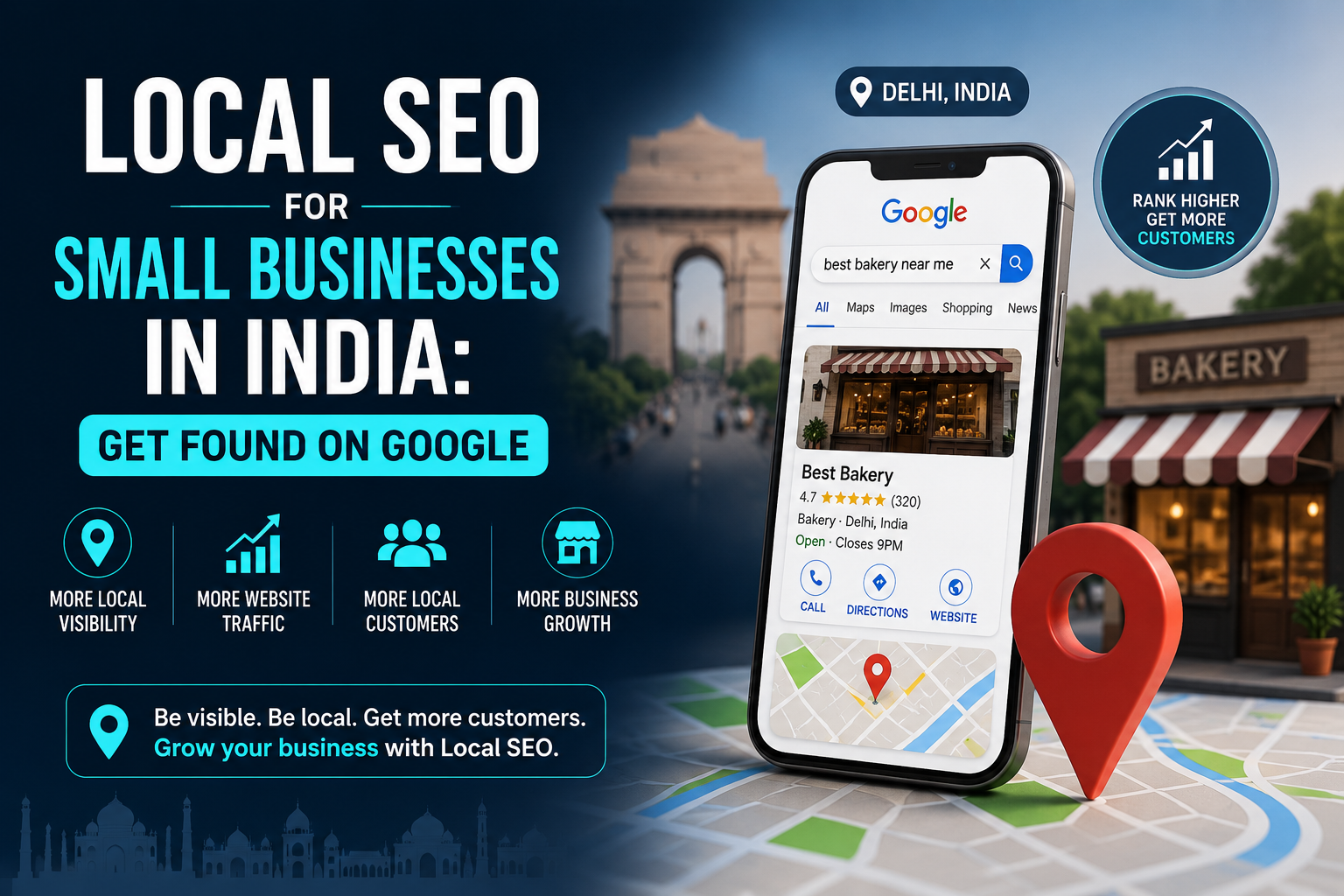
If you run a small business in India, your next customer may already be searching for exactly what you sell.
They might type "dentist near me," "best interior designer in Delhi," "AC repair in Noida," "CA in Lajpat Nagar," or "website development company in Delhi" into Google.
The businesses that appear when those searches happen have a major advantage: they are visible at the exact moment a potential customer is looking for them.
That is what local SEO is designed to achieve.
Local SEO is the process of improving your business's visibility in location-based searches on Google Search and Google Maps. For a small business, it can be one of the most practical ways to generate consistent enquiries without depending entirely on paid advertising.
And you do not need to be a large company to compete.
You need the right local SEO foundation, accurate business information, a useful website, genuine reviews, and a consistent presence across the places where Google expects to find information about your business.
What Is Local SEO?
Local SEO is SEO focused on helping a business appear in searches connected to a specific geographic area.
Traditional SEO might target a search such as "best accounting software for small businesses."
Local SEO targets searches such as:
- "CA near me"
- "accountant in Delhi"
- "best salon in Gurgaon"
- "plumber in Noida"
- "dentist in South Delhi"
- "real estate agent in Mumbai"
- "digital marketing agency in Bangalore"
The goal is simple:
When someone nearby searches for the product or service you provide, your business should have a chance of being discovered.
Google says local results are primarily influenced by relevance, distance, and prominence. That means your business needs to clearly match what the customer is searching for, be appropriately located for the search, and demonstrate that it is a credible and established business. citeturn0search0
For small businesses, that makes local SEO much more than adding a city name to a website.
It is about building a complete local presence that Google and customers can understand.
Why Local SEO Matters for Small Businesses in India
India has a massive online audience. DataReportal reported 806 million internet users in India at the start of 2025, representing 55.3% internet penetration. citeturn0search12
But you do not need millions of visitors.
A local business often needs the right few hundred people to discover it.
If you are a dentist in Delhi, you do not need someone in Chennai to visit your website. You need people in the areas you actually serve to find you when they need dental care.
If you own a home renovation company in Gurgaon, ranking for a broad national keyword may be less valuable than appearing for searches such as:
"home renovation contractor Gurgaon"
or
"modular kitchen designer near me."
That is the power of local search.
The customer already has a need.
Your job is to make sure your business can be found when that need becomes a search.
How Local Search Works on Google
When someone searches for a local business, Google can show results across both Google Search and Google Maps. Business Profile information can help Google understand what the business does, where it operates, and how customers can interact with it. citeturn0search1
Google's local ranking system primarily considers three areas:
1. Relevance
Does your business match what the person is searching for?
A business that clearly identifies itself as a dental clinic is more relevant to "dentist near me" than a business with vague information about healthcare.
Your category, services, website content, business description, and other information should clearly communicate what you actually offer.
2. Distance
How close is the business to the searcher or the location included in the search?
Someone searching for "restaurant near me" is generally looking for businesses close to their current location.
Distance is not something you can manipulate with SEO. Your job is to make your actual service area and location information clear and accurate.
3. Prominence
How well-known is the business?
Google considers information it has about a business across the web. Reviews, links, and other signals can contribute to prominence. citeturn0search0
This is where a strong website, genuine customer reviews, mentions on relevant websites, and a consistent online presence become important.
The Most Important Part of Local SEO: Your Google Business Profile
If you serve customers locally, your Google Business Profile should be one of the first things you optimize.
It is the business listing that can appear when people search for your business or related services on Google Search and Maps.
A complete profile gives Google and potential customers useful information such as:
- Your business name
- Primary business category
- Address or service area
- Phone number
- Opening hours
- Website
- Services
- Photos
- Reviews
- Business attributes
- Other relevant information
Google specifically recommends keeping Business Profile information complete and accurate because this helps customers understand what the business does, where it is, and when it is available. citeturn0search0
Do not treat your Google Business Profile like a one-time setup
A common mistake is creating the profile, adding a phone number, uploading a logo, and then never touching it again.
Your profile should remain accurate as your business changes.
Update:
- Opening hours
- Holiday hours
- Services
- Photos
- Contact information
- Website URL
- Business attributes
- Relevant business information
Most importantly, do not add information that is not true just because you think it will help you rank.
Local SEO works best when your online presence accurately represents the real business.
Choose the Right Primary Business Category
Your primary category helps Google understand what your business is.
For example, if you operate a dental clinic, your primary category should accurately represent that business.
If you run a restaurant, choose the category that best describes the restaurant.
Do not choose a category simply because you think it has more searches.
The objective is not to trick Google.
The objective is to make your business more relevant to the searches you genuinely want to appear for.
You can also use relevant secondary categories where appropriate, but avoid adding unrelated categories.
Build a Website for Local Search
A Google Business Profile is important, but it should not be your entire local SEO strategy.
Your website gives Google much more context about your business.
Google can use publicly available information from a business's official website and other sources when compiling information for local search. citeturn0search1
Your website should clearly communicate:
- What you do
- Where you operate
- Who you serve
- What services you provide
- Why customers should choose you
- How customers can contact you
For a local business, this means your homepage should not leave Google guessing about your location or services.
Create Dedicated Service Pages
One of the strongest local SEO improvements you can make is creating useful pages for your important services.
For example, a Delhi interior design company might have:
- Interior Design Services in Delhi
- Home Interior Design in Delhi
- Modular Kitchen Design in Delhi
- Office Interior Design in Delhi
A digital marketing agency might have:
- Digital Marketing Services in Delhi
- Local SEO Services in Delhi
- Website Design Services in Delhi
- Google Business Profile Optimization
The important word is useful.
Do not create dozens of nearly identical pages with only the city name changed.
Each page should genuinely help the customer understand the service, the areas served, your process, examples of your work, and how to contact you.
Target Local Keywords That Customers Actually Search
Local keyword research does not need to be complicated.
Start with the services you sell and combine them with the locations you actually serve.
For example:
Service + City
- Dentist Delhi
- Web design Delhi
- Plumber Gurgaon
- Interior designer Mumbai
Service + Area
- Dentist in Lajpat Nagar
- CA in Rohini
- Salon in Indiranagar
- Restaurant in Koramangala
Service + Intent
- Best dentist near me
- Emergency plumber near me
- Website developer near me
- Home renovation contractor near me
Service + Problem
- AC not cooling repair Delhi
- GST registration consultant Noida
- Website redesign for small business Delhi
Do not force keywords into every sentence.
Use them naturally in page titles, headings, body copy, image context, internal links, and other relevant areas.
Google's goal is to connect users with relevant businesses, so your content should be written for the customer first.
Optimize Your Homepage for Your Location
Your homepage is often the strongest page on your website.
Make it immediately clear:
What you do + where you do it + who you help.
For example:
Website Design & Development Company in Delhi for Small Businesses
is much clearer for local search than:
We Build Digital Experiences That Transform Businesses
The second headline may sound impressive, but it gives both customers and search engines less immediate context.
A strong local homepage should include:
- Your main service
- Primary location
- Service areas
- Clear value proposition
- Testimonials
- Relevant work or case studies
- Contact information
- WhatsApp or call CTA
- Links to service pages
Get Genuine Google Reviews
Reviews are one of the most important trust signals for a local business.
But the goal should not simply be to collect a large number of five-star reviews.
The goal is to consistently deliver a good customer experience and make it easy for genuine customers to share honest feedback.
Google recommends responding to reviews and notes that reviews and helpful responses can help a business stand out. citeturn0search0
After completing a project or delivering a service, you can send customers a direct review request.
For example:
Thank you for choosing us. If you were happy with our service, we would really appreciate an honest Google review. Your feedback helps our small business.
Simple.
Do not buy fake reviews.
Do not create reviews for yourself.
Do not pressure customers to leave misleading feedback.
A smaller number of genuine reviews is far more valuable than a collection of artificial ones.
Respond to Your Reviews
Getting reviews is only half the job.
Respond to them.
For positive reviews, thank the customer and acknowledge what they mentioned.
For negative reviews, remain professional and focus on resolving the problem.
For example:
Thank you for sharing your experience, Rahul. We're glad you were happy with the website redesign and support.
A thoughtful response can also show future customers that your business is active and pays attention to its customers.
Add Real Photos to Your Business Profile
Photos help potential customers understand what your business actually looks like.
Depending on your business, upload:
- Exterior photos
- Interior photos
- Team photos
- Product photos
- Before-and-after projects
- Completed work
- Equipment
- Service photos
- Office or store photos
Do not rely entirely on stock images.
A customer looking for a local business wants evidence that the business is real.
Google also recommends adding photos and videos to Business Profiles to help customers understand what the business offers. citeturn0search0
Keep Your Business Information Consistent
Your business information should be consistent wherever your company appears online.
Pay particular attention to:
Business name
Address
Phone number
Website
This information should not randomly change between your website, Google Business Profile, directories, social profiles, and other relevant listings.
Consistency makes it easier for customers and search engines to understand that the different listings refer to the same business.
Build Local Citations Carefully
A citation is a mention of your business on another website, often containing information such as your business name, address, phone number, website, or category.
Examples can include:
- Relevant business directories
- Local directories
- Industry associations
- Chamber of commerce websites
- Local publications
- Supplier or partner websites
- Relevant business listings
Do not submit your business to hundreds of low-quality directories simply to create links.
Focus on relevant and trustworthy places.
Local SEO is not a numbers game where more directories automatically mean better rankings.
Quality and relevance matter.
Earn Local Backlinks
A backlink is a link from another website to your website.
For local businesses, relevant local links can help strengthen your online presence.
For example:
A Delhi interior designer might earn a link from:
- A Delhi architecture publication
- A local home improvement website
- A property developer
- A local business association
- A relevant interior design publication
A restaurant might earn coverage from a local food publication.
A lawyer might be mentioned by a professional organization or local publication.
The strongest backlinks are earned because your business has something worth mentioning.
Think:
Useful relationship → genuine mention → relevant link
not:
Buy 500 backlinks → rank tomorrow
Create Local Content That Helps Customers
Local SEO content does not mean publishing the same generic article 50 times with different city names.
Create content around questions your local customers actually have.
For example, a home renovation company could publish:
- How Much Does Home Renovation Cost in Delhi in 2026?
- Best Materials for a Delhi Apartment Renovation
- How Long Does a Home Renovation Take?
- Modular Kitchen Cost in Delhi: What Affects the Price?
- 10 Questions to Ask Before Hiring a Contractor
A dentist could publish:
- How Much Does Teeth Cleaning Cost in Delhi?
- What to Expect During a Root Canal
- How Often Should You Visit a Dentist?
- Dental Emergency: When Should You Seek Immediate Help?
This type of content can attract people before they are ready to buy.
And when they are ready, your business is already familiar to them.
Add Local Business Structured Data
If you have a website, structured data can help search engines understand important information about your business.
For eligible businesses, Google supports LocalBusiness structured data.
Depending on your business, this can communicate information such as:
- Business type
- Name
- Address
- Opening hours
- Phone number
- Website
- Location
- Other supported details
Structured data is not a magic ranking button.
It does not guarantee that your business will rank higher.
Its purpose is to provide machine-readable information that can help search engines understand the page and business.
Use accurate information that matches what customers can actually find on your site and business profile.
Make Your Website Mobile-Friendly
A large portion of local searches happen on mobile devices.
That means your website needs to work properly on a phone.
A customer searching for:
"electrician near me"
does not want to pinch and zoom around a broken desktop layout.
Your mobile website should make it easy to:
- Call
- Get directions
- View services
- Read reviews
- Submit an enquiry
- Find your address
- Understand what you offer
Local SEO gets people to your website.
Good mobile UX helps turn those visitors into customers.
Make Your Contact Information Easy to Find
Do not hide your phone number on a page nobody visits.
Put important contact information where customers can easily find it.
Your website should ideally include:
- Phone number
- WhatsApp button
- Business address, when applicable
- Service area
- Opening hours
- Contact form
- Google Maps location, when appropriate
For local businesses, every additional step between a customer and your business can reduce the chance of an enquiry.
Make contacting you easy.
Create a Strong Local SEO Funnel
Local SEO should not stop when someone clicks your website.
The complete journey should look like this:
- Customer searches Google
- Your Business Profile or website appears
- Customer checks your reviews
- Customer visits your website
- Customer reviews your services and work
- Customer sees your contact options
- Customer calls, messages, or submits an enquiry
- You follow up and close the customer
This is why local SEO and website conversion optimization should work together.
Ranking is not the final goal.
Customers are.
What Local SEO Does Not Mean
There are several misconceptions about local SEO.
Local SEO does not mean stuffing your city name everywhere
Writing:
Best Delhi Delhi SEO Company Delhi SEO Services Delhi
does not create a better page.
It creates a terrible page.
Use location terms naturally.
Local SEO does not guarantee a #1 ranking
Google does not provide a way for businesses to pay for or request a better local ranking. citeturn0search0
No legitimate SEO professional can guarantee that your business will permanently occupy the first position.
Local SEO is not only Google Maps
Maps visibility is important, but your website, organic search visibility, reviews, local mentions, and overall online presence also matter.
Local SEO is not an overnight strategy
Some changes can produce improvements quickly.
But building strong local visibility usually takes consistent work.
Your competitors are also building reviews, content, links, and better websites.
Local SEO is a process, not a one-time switch.
10 Local SEO Mistakes Indian Small Businesses Make
1. Creating a Google Business Profile and forgetting about it
A profile should stay accurate and complete.
2. Using the wrong business category
Your primary category should accurately represent your real business.
3. Having no website
Your profile tells Google basic information. A website gives customers and search engines much more context.
4. Using fake reviews
Fake reviews can damage trust and violate platform policies.
5. Keyword stuffing
Repeating "best [service] in [city]" everywhere makes content worse, not better.
6. Creating duplicate location pages
Do not create dozens of thin pages that are almost identical except for the city name.
7. Ignoring negative reviews
A professional response is better than pretending the complaint does not exist.
8. Using outdated business information
Wrong hours or phone numbers can directly cost enquiries.
9. Buying cheap backlinks
Hundreds of irrelevant links are not a substitute for genuine authority.
10. Measuring only rankings
Track business outcomes too:
- Calls
- Website enquiries
- WhatsApp conversations
- Direction requests
- Form submissions
- Qualified leads
- Customers generated
The purpose of local SEO is business growth.
The Local SEO Checklist for Small Businesses in India
If you want a practical starting point, work through this checklist:
Google Business Profile:
- [ ] Profile claimed and verified
- [ ] Correct primary category selected
- [ ] Relevant secondary categories added where appropriate
- [ ] Business description completed accurately
- [ ] Phone number correct
- [ ] Website linked
- [ ] Hours updated
- [ ] Services added
- [ ] Relevant attributes completed
- [ ] High-quality real photos uploaded
- [ ] Genuine customer reviews requested
- [ ] Reviews answered professionally
Website:
- [ ] Business name clearly visible
- [ ] Location clearly stated
- [ ] Main services clearly explained
- [ ] Dedicated service pages created
- [ ] Important local keywords used naturally
- [ ] Phone and WhatsApp CTA visible
- [ ] Contact page complete
- [ ] Mobile-friendly design
- [ ] Fast, usable pages
- [ ] Internal links between relevant pages
- [ ] LocalBusiness structured data considered
- [ ] Google Search Console configured
- [ ] Analytics configured
Local authority:
- [ ] Relevant local directories
- [ ] Industry listings
- [ ] Local partnerships
- [ ] Relevant local backlinks
- [ ] Consistent business information
- [ ] Useful local content
A Simple 90-Day Local SEO Plan
You do not need to do everything on day one.
Days 1–30: Build the Foundation
Start with:
- Google Business Profile
- Business categories
- Accurate contact information
- Business hours
- Services
- Photos
- Website homepage
- Contact page
- Main service pages
- Mobile optimization
- Search Console and analytics
The goal is to make your business understandable to both customers and Google.
Days 31–60: Build Trust
Focus on:
- Genuine customer reviews
- Review responses
- New business photos
- Local content
- Relevant directories
- Industry listings
- Internal linking
- Improving service pages
The goal is to strengthen relevance and credibility.
Days 61–90: Build Authority
Now focus on:
- Local partnerships
- Digital PR
- Relevant backlinks
- More useful local content
- Conversion optimization
- Tracking calls and enquiries
- Identifying which keywords and pages generate leads
The goal is to turn your local visibility into a repeatable acquisition channel.
How to Measure Local SEO Success
Do not judge your SEO only by asking:
"Am I #1 on Google?"
Track the metrics that matter to your business.
Visibility
- Local search impressions
- Google Maps visibility
- Organic impressions
- Search queries
Engagement
- Website clicks
- Phone calls
- WhatsApp clicks
- Direction requests
- Contact form submissions
Business results
- Qualified enquiries
- Sales opportunities
- Customers acquired
- Revenue generated
A ranking is useful.
A customer is better.
Local SEO + Website: The Strategy That Compounds
Your Google Business Profile is one part of the system.
Your website is another.
Your reviews are another.
Your local content, backlinks, and reputation are additional pieces.
Together, they create something much stronger than any single channel.
The flow looks like this:
- Customer searches Google
- Finds your Business Profile
- Sees reviews and photos
- Visits your website
- Reads your service information
- Builds trust
- Calls or sends a WhatsApp message
- Becomes a lead
- Becomes a customer
- Leaves a genuine review
- Your online reputation becomes stronger
That creates a cycle.
More visibility → more customers → more reviews → stronger trust → more visibility.
That is why local SEO can become a long-term acquisition asset for a small business.
How Much Does Local SEO Cost in India?
The cost depends heavily on the competitiveness of your industry, location, current website, and how much work needs to be done.
A local business in a smaller city targeting a relatively narrow service may need a much smaller SEO campaign than a highly competitive business targeting a major city such as Delhi, Mumbai, Bangalore, or Hyderabad.
Your costs may include:
- Website development or improvements
- SEO strategy
- Content creation
- Local landing pages
- Google Business Profile optimization
- Citation management
- Link building
- Technical SEO
- Ongoing reporting
The right question is not simply:
"How much does local SEO cost?"
It is:
"How much is one new customer worth to my business, and how many additional customers could local search generate?"
If one new customer is worth ₹25,000 to your business, investing in a system that consistently generates qualified enquiries can make sense very quickly.
Key Takeaways
- Local SEO helps small businesses become visible when nearby customers search for their products or services.
- Google says local rankings are primarily based on relevance, distance, and prominence.
- A complete and accurate Google Business Profile is one of the most important foundations of local SEO.
- Your website should clearly communicate what you do, where you operate, and which services you provide.
- Dedicated service and location pages can help your website target relevant local searches when they provide genuine value.
- Genuine reviews, professional responses, real photos, relevant links, and consistent business information strengthen your local presence.
- Local SEO is not the same as keyword stuffing or creating hundreds of thin city pages.
- Rankings are useful, but calls, enquiries, leads, customers, and revenue are better measures of success.
- The strongest local strategy combines Google Business Profile, a professional website, reviews, useful content, and local authority.
- Local SEO is not an overnight trick. It is a long-term digital asset that can keep generating visibility and enquiries.
Conclusion
Your customers are already searching.
They are searching for dentists, accountants, restaurants, contractors, real estate agents, salons, repair services, consultants, agencies, and hundreds of other businesses every day.
The question is not whether people are searching.
The question is:
Will they find you - or your competitor?
For a small business in India, local SEO gives you a way to compete for customers who are already looking for what you sell.
Start with your Google Business Profile.
Build a website that clearly explains your services and locations.
Create useful local content.
Collect genuine reviews.
Keep your information accurate.
Build real local authority.
And most importantly, make it easy for the person who finds you to become a customer.
Local SEO is not about chasing Google.
It is about making your business easier to discover, easier to trust, and easier to contact.
Work With SmarterDigi
At SmarterDigi, we build professional websites for Indian small businesses with SEO, local visibility, and lead generation in mind.
We can help you build the foundation you need to get discovered online - from a professional business website and local SEO structure to conversion-focused pages and WhatsApp integration.
Explore Our SEO Services or explore all our services to find the right fit for your business.
Frequently Asked Questions
What is local SEO for small businesses in India?
Local SEO is the process of improving a business's visibility for searches connected to a specific location. It helps businesses appear in relevant Google Search and Google Maps results when people search for nearby products or services.
How do I get my small business found on Google in India?
Start by creating and verifying your Google Business Profile, making sure your business information is complete and accurate, and building a useful website with clear service and location information. Then focus on genuine reviews, relevant local content, consistent business information, and other trustworthy signals that strengthen your local presence.
Is Google Business Profile free?
Google provides Business Profile as a free way for eligible businesses to manage how their business information appears on Google Search and Maps. You can improve the profile by keeping information accurate, adding relevant details and photos, and responding to customer reviews.
Does having a website help local SEO?
Yes. A website gives Google and potential customers additional information about your business, services, locations, and expertise. Google can use information from a business's official website when compiling information for local search.
How long does local SEO take to work?
There is no universal timeline. Results depend on your location, industry competition, current online presence, website quality, reviews, authority, and the amount of work being done. Some improvements can appear relatively quickly, while meaningful local visibility often requires consistent work over time.
How many Google reviews do I need to rank locally?
There is no fixed number of reviews that guarantees a ranking. Google says reviews and ratings can contribute to local ranking, but local results are influenced by multiple factors including relevance, distance, and prominence. Focus on consistently earning genuine customer feedback rather than chasing a specific number.
Should I create a separate Google Business Profile for every city I serve?
Not automatically. Your Business Profile should represent a real eligible business location or service-area business according to Google's guidelines. Do not create fake locations simply to target more cities.
Should I target every area around my city?
No. Focus on locations you genuinely serve. Create useful location-focused content only where you can provide real value to customers in that area.
Can local SEO replace Google Ads?
Not necessarily. SEO and paid advertising serve different purposes. Local SEO can build long-term organic visibility, while Google Ads can provide paid visibility when you need it. Many businesses can use both strategically.
What is the biggest local SEO mistake small businesses make?
The biggest mistake is treating local SEO as a one-time Google Business Profile setup. A strong local presence requires accurate business information, a useful website, genuine reviews, relevant content, and ongoing attention to how customers discover and interact with the business.
The Author
Meraj Ahmad
Founder, developer, and SEO strategist with 10+ years of experience building websites and digital solutions. Worked with brands like Short Story Lovers, The Muthoot Group, and IFFCO.