

10 Small Business Website Mistakes That Are Costing You Leads in India
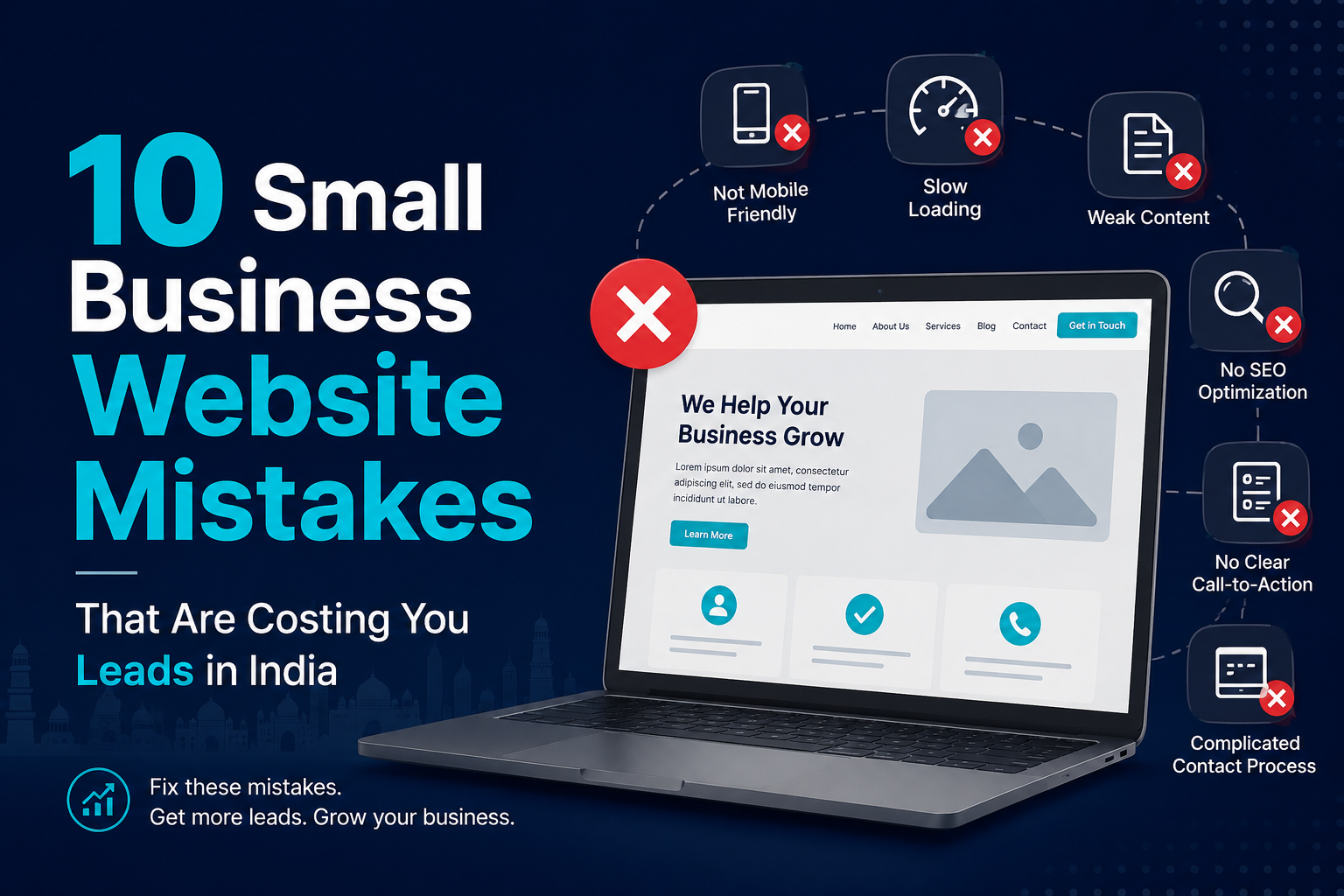
Here is a situation that plays out every month across India.
A business owner spends ₹40,000 to ₹1,50,000 building a website. The agency delivers something clean and mobile-friendly. The site goes live. Family and friends get the link. A few people visit. And then - nothing. No calls. No form fills. No WhatsApp messages. Zero leads.
Six months later, the website is still live. It still looks decent. But it has not generated a single rupee of business.
This is not rare. It is extremely common - across coaching centres in Chandigarh, consultancies in Mumbai, clinics in Hyderabad, and agencies in Delhi. In fact, after auditing over 200 Indian small business websites, we found that 91% had at least three critical mistakes actively suppressing their ability to generate leads.
The reason is almost never the industry, the budget, or bad luck. It is one or more of the ten mistakes below - mistakes that are completely fixable once you know what to look for. Every mistake in this list comes with a diagnosis and a concrete fix you can act on today.
Why Indian Small Business Websites Fail: The Core Problem
Before diving into the individual mistakes, it helps to understand the root cause behind all of them.
Most Indian small business websites are built with one goal: to look good. The agency presents mockups, the business owner approves the design, and the site gets built based on how it looks - not on how it performs.
A website built to look good is a brochure. A website built to perform is a sales system. The difference between them is not visible in a screenshot - it shows up in your enquiry inbox, or the absence of one.
The ten mistakes below are what happen when a website is designed for appearance instead of performance. Each one is a gap between what your website is doing and what it should be doing to generate consistent leads.
Mistake 1: No Clear Value Proposition Above the Fold
What the mistake looks like:
Your homepage opens with a beautiful banner image, your company name in large letters, and a vague tagline like "Excellence in Every Service," "Your Trusted Partner for Growth," or "Quality You Can Count On." Below that sits a long paragraph about your company's journey, your founding story, and your commitment to customer satisfaction.
This is how the majority of Indian small business websites open. And it is why the majority of them generate no leads.
Why it kills leads:
Visitors decide within 3 seconds whether to stay on your website or hit the back button. This is not a theory - it is a measurable, documented behaviour. According to a 2026 web usability study, 79% of users dissatisfied with a website's first impression never return to that site.
The moment a visitor lands on your homepage, they are asking one question: "Is this relevant to me?" A generic tagline does not answer that question. A company history does not answer that question. Only a specific, direct statement of what you do, who you help, and what they should do next answers that question.
Your homepage hero section is not a branding exercise. It is your most important sales statement - the difference between a visitor who stays and one who leaves forever.
The fix:
Rewrite your hero section to answer three questions within the first five seconds of a visitor's experience:
- What do you do? Be specific. Not "We provide digital solutions" - "We build lead-generating websites for small businesses in India."
- Who do you help? Not "businesses of all sizes" - "Coaches, consultants, clinics, and agencies across Delhi NCR."
- What should they do next? One clear action. "Book a free 30-minute strategy call." "Get a free website audit." "WhatsApp us now."
The formula that works: [What you do] + [Who you help] + [One clear CTA].
Test your current hero section by asking someone who has never seen your website to read it for five seconds and then explain what your business does. If they cannot answer accurately, your value proposition needs rewriting before anything else.
Specific, outcome-focused language converts. Generic branding language does not - regardless of how beautiful the design is.
Mistake 2: Your Website Is Slow - Especially on Mobile
What the mistake looks like:
Your website takes 6 to 10 seconds to load. On a desktop with a broadband connection, it feels sluggish but acceptable. On a mobile data connection in a tier-2 city, it is painfully slow. You have probably never tested it on a phone using a 4G connection - and neither has your developer.
The most common causes in India: cheap shared hosting, uncompressed images uploaded at 3–5MB each, too many plugins, unminified CSS and JavaScript files, and no content delivery network (CDN).
Why it kills leads:
Google directly factors site speed into search rankings, making poor performance both a usability and SEO problem simultaneously. Beyond rankings, every second of loading time costs you conversions in a measurable way. Google's own research shows that 53% of mobile users abandon a site that takes longer than 3 seconds to load. At 5 seconds, the abandonment rate jumps to 90%.
In India, this problem is amplified for two reasons. First, over 75% of Indian web traffic comes from mobile devices. Second, a significant portion of India's mobile users - particularly in tier-2 and tier-3 cities - are on 4G connections that vary significantly in speed depending on location and time of day. A website that loads in 3 seconds on a Delhi Jio connection may take 8 seconds in a smaller city on an older network.
Every visitor who leaves because your page did not load fast enough is a potential customer who has now gone to a competitor. They will not come back.
The fix:
Start by testing your site right now at pagespeed.web.dev. Run the test on mobile - not desktop. Aim for a score above 85 on mobile. Below 50 is a serious problem that is actively costing you both rankings and conversions.
The fixes in order of impact:
- Switch hosting. Cheap shared hosting - anything under ₹3,000/year - is the single most common cause of slow websites in India. Move to a VPS or cloud hosting provider. This single change can improve load times by 40–60%.
- Compress and convert images. Every image on your site should be in WebP format and compressed to under 100KB where possible. Tools like Squoosh (free, browser-based) make this straightforward.
- Remove unused plugins. Every plugin you install adds code that the browser must download and process. Audit your plugins quarterly and remove anything not actively being used.
- Enable caching. A caching plugin (WP Rocket, W3 Total Cache) stores a pre-built version of your pages so they load instantly for repeat visitors.
- Use a CDN. A content delivery network serves your site from servers geographically close to your visitors. Cloudflare has a free tier that significantly improves load times across India.
A slow website is not a technical problem. It is a revenue problem - and it compounds every day it goes unfixed.
Mistake 3: Built for Desktop, Broken on Mobile
What the mistake looks like:
You built your website on a laptop and reviewed it on a laptop. It looks great at 1440px wide. But on a smartphone - the device that 75% of your actual visitors are using - text is tiny, images overflow the screen, buttons are impossible to tap with a thumb, and the navigation menu collapses into something that requires three attempts to open.
This happens because many Indian web developers and agencies still design desktop-first and then attempt to make it "responsive" by adding media queries - rather than building mobile-first from the start. The result is a desktop website that technically works on mobile but was never designed for it.
Why it kills leads:
Mobile visitors are often the most ready to act. Someone searching for "electrician in Noida" on their phone at 7pm is not browsing casually - they have a problem and they want it solved. A slow or cluttered mobile experience turns that high-intent visitor into a bounce. Over 75% of Indian web traffic comes from mobile devices. If your site is broken on mobile, you are losing three quarters of your potential customers before they read a single word about your business.
Beyond conversion, Google now indexes and ranks the mobile version of your website first - not the desktop version. If your mobile experience is poor, your rankings suffer everywhere, including on desktop searches.
The fix:
Open your website on at least three different smartphones right now - your own, a family member's, and a friend's - and test every page on each of them. Look specifically for:
- Text that requires zooming to read
- Buttons smaller than a thumb tap (anything under 44x44 pixels)
- Images that overflow horizontally and cause sideways scrolling
- Navigation menus that are difficult to open or use
- Forms with fields too small to type in accurately
- Phone numbers that are not clickable (tap-to-call)
Every one of these issues drives mobile visitors away. The fixes range from CSS adjustments for most layout problems, to a full mobile-first rebuild if the underlying structure is fundamentally desktop-oriented.
The minimum standard in 2026: your website should be indistinguishable in quality between mobile and desktop. Not "functional on mobile" - genuinely excellent on mobile.
Mistake 4: Weak or Missing Calls to Action
What the mistake looks like:
Your website has one contact page with a form buried at the bottom. Every service page ends with "For more information, feel free to reach out to us." Your homepage has a beautiful hero image and no CTA anywhere in the first screen. Your blog posts end with the last paragraph of content and nothing else.
Alternatively - and this is equally common - your website has too many CTAs competing with each other: "Call us," "Email us," "Fill this form," "WhatsApp us," "Download our brochure," "Subscribe to our newsletter" all appearing on the same page, creating decision paralysis rather than action.
Why it kills leads:
Visitors do not self-direct. They follow the path you create for them. If there is no clear next step, they do nothing - not because they are uninterested, but because taking action requires effort you have not removed for them. The number one reason Indian business websites generate no leads is that they were built to look good, not to convert. A beautiful homepage with no clear call to action, a contact form buried at the bottom, and no reason for a visitor to act is the most common configuration we see across Indian small business websites in 2026.
The psychology is simple: every extra decision a visitor has to make reduces the probability they make any decision at all. Your job is to remove decisions, not add them.
The fix:
Every page on your website should have one primary CTA - one clear action you want visitors to take. Not two. Not five. One.
For Indian service businesses, the highest-converting CTAs in 2026 are:
- "WhatsApp Us Now" - the most frictionless option for Indian customers. A WhatsApp click-to-chat button with a pre-filled message ("Hi, I found your website and want to enquire about your services") converts significantly better than a generic form.
- "Book a Free 30-Minute Call" - works well for consultants, coaches, agencies, and any business where a conversation is the natural next step.
- "Get a Free Quote" - effective for service businesses where pricing is the customer's primary question.
- "Request a Callback" - lower commitment than a form, higher conversion for customers who prefer to be called rather than to initiate.
Place your primary CTA: above the fold on every key page (visible without scrolling), at the midpoint of long service pages, and at the end of every page and blog post. Add a sticky header or footer bar that keeps your WhatsApp button visible at all times as visitors scroll.
One well-placed, specific CTA outperforms five generic ones every time.
Mistake 5: No Trust Signals for Indian Customers
What the mistake looks like:
Your website makes claims - "10 years of experience," "500+ satisfied clients," "Industry-leading quality" - but provides no evidence for any of them. There are no testimonials with real names. No case studies with actual results. No photos of real work. No GST number. No physical address. No verifiable proof that anyone has ever paid you for anything and been satisfied.
This is extremely common on Indian small business websites, and it is one of the most damaging mistakes of all.
Why it kills leads:
Indian customers are cautious - and for good reason. The Indian online market has seen its share of fraud, undelivered promises, and disappeared vendors. Before a potential customer contacts your business, they are actively trying to verify that you are legitimate, established, and trustworthy. They look for social proof. They look for credentials. They look for evidence that real people have trusted you and been satisfied.
A website full of claims with no evidence does not build trust. It creates doubt. The implicit question every uncredentialled claim raises is: "If this were true, why wouldn't they show me proof?"
The fix - what Indian customers specifically look for:
Testimonials with full names, photos, and specifics. Not "Great service! - R.K." That is useless. Real testimonials name the client, mention the specific service, and describe a concrete outcome: "SmarterDigi built our clinic website in three weeks. Within two months we were getting 15–20 online appointment bookings per week that we weren't getting before. Highly recommended. - Dr. Priya Sharma, Delhi."
Case studies with before/after metrics. Numbers are credible in a way that adjectives are not. "Increased enquiries from 8 to 47 per month" is believable. "Dramatically improved our lead generation" is not.
Your GST number in the footer. This is a uniquely important trust signal for Indian customers. A displayed GST number proves you are a registered, tax-compliant business - not a fly-by-night operation. This single addition meaningfully increases the conversion rate of first-time visitors.
A physical address. Even a registered office address. Businesses with no physical address raise immediate suspicion with Indian customers.
Google review widget. Your live Google rating, displayed on your website, provides third-party validation that cannot be faked or curated the way testimonials can.
Real photos of your team and work. Not stock photos of smiling Western businesspeople in glass offices. Photos of your actual team, your actual workspace, and your actual completed work. Authenticity is a trust signal. Stock imagery is a trust killer.
Client logos. If you have worked with recognisable brands - even locally recognisable ones - display their logos prominently. Association with known entities transfers credibility.
Trust is not claimed. It is demonstrated. Every claim on your website needs evidence beside it - and that evidence needs to be specific, verifiable, and Indian in context.
Mistake 6: No SEO Foundation - Google Cannot Find You
What the mistake looks like:
Your website has been live for 12 months. It receives 80–120 visitors per month - almost all of them people you have personally shared the link with. When you search for your service plus your city on Google, your website does not appear anywhere on the first three pages.
Your page titles say "Home," "Services," and "About Us." There is no metadata. Your image filenames are "IMG_20240312_154823.jpg." Your URLs look like /page?id=47. You have never heard of Google Search Console. No sitemap has been submitted to Google.
Why it kills leads:
If Google cannot find your website, neither can your customers. Over 90% of searchers never go past the first page of Google results. For local searches - "accountant in Pune," "interior designer South Delhi," "website developer Bangalore" - appearing in the top five results is the difference between consistent lead flow and silence.
A website with no SEO foundation is invisible to every potential customer searching for your service right now. It can look spectacular and still generate zero leads, because no one outside your existing network ever finds it.
Ignoring local search is particularly damaging for Indian service businesses. Google's Local Pack - the map showing three local businesses above the organic results - appears for the majority of service-based local searches and drives a disproportionate share of enquiries and calls.
The fix:
SEO cannot be bolted on after a website is built - it needs to be built into the foundation. But if your site is already live without it, these are the highest-impact fixes:
- Keyword research first. Find the exact terms your customers search. Use Google's autocomplete, the "People also search for" section, and Google Keyword Planner with your city set as the target. "Website developer Delhi" and "affordable website design in Delhi" are different keywords targeting different intents - both matter.
- Rewrite every page title. Format: Primary Keyword - Secondary Keyword | Brand Name. "Website Design Services in Delhi | SmarterDigi" is a page title. "Services" is not.
- Write unique meta descriptions for every page. Under 160 characters. Include the primary keyword naturally. This does not directly affect rankings but significantly affects click-through rates from search results.
- Fix your URL structure.
/services/website-design-delhioutperforms/page?id=47in every possible way. - Add your city and service area naturally to page content. Not stuffed - naturally written. "We provide website design services across Delhi NCR, including Noida, Gurgaon, and Faridabad."
- Set up Google Search Console. Free. Shows you exactly which queries your site is appearing for, which pages are indexed, and any crawl errors Google has encountered.
- Submit your XML sitemap to Google Search Console so Google can find and index all your pages.
- Implement LocalBusiness schema markup. Structured data that tells Google explicitly what type of business you are, where you are located, and what you offer.
Our complete guide to local SEO for small businesses in India covers every one of these steps in full detail.
Mistake 7: Confusing Navigation and No Clear Customer Journey
What the mistake looks like:
Your navigation menu has 12 items across two rows. Some of those items lead to pages that dead-end with no next step. Your services are spread across multiple overlapping pages with no clear distinction between them. Clicking "About" takes you to a page with no link to your services. Your blog has no internal links. A visitor who lands on any page other than your homepage has no obvious path to contact you.
Alternatively - and this is equally common in India - the navigation is so simplified that visitors cannot find the information they need and give up.
Why it kills leads:
In 2026, the biggest web design mistakes are often small moments of doubt. A local customer lands on a page, cannot tell if the business serves their area, gets stuck trying to find pricing information, and quietly moves on to a competitor who is easier to navigate. Every moment of confusion is a step closer to the back button - and once a visitor leaves, they rarely return.
A confused visitor is a lost lead. Navigation confusion is invisible to the business owner (who knows the site intimately) but immediately apparent to a first-time visitor (who is seeing it with fresh eyes).
The fix:
Simplify your main navigation to a maximum of 6 items. The standard structure for an Indian service business website:
Home → Services → About → Portfolio/Work → Blog → Contact
If you offer multiple services, use a dropdown under "Services" rather than listing each service as a top-level menu item.
Map every page to a specific customer intent. Before building or redesigning any page, ask: what does someone landing here already know, and what do they need to do next? Every page should have a clear answer to the second question.
Add internal links throughout your content. Every service page should link to related service pages and to your contact page. Every blog post should link to relevant service pages. Internal linking keeps visitors on your site longer and improves your SEO simultaneously.
Add a sticky header that keeps your phone number or WhatsApp button visible at all times. A visitor should be able to contact you from any point on any page with a single tap - without having to scroll back to the top or navigate to the contact page.
Test your site as a stranger. Give your URL to someone who has never seen it and watch them try to find your main service and your contact information. Where they hesitate, get confused, or give up - that is where your navigation needs work.
Mistake 8: Generic Stock Photos and No Real Brand Identity
What the mistake looks like:
Your homepage features smiling Western business people in a glass-walled conference room that has nothing to do with your business or your city. Your about page has no photos of your actual team. Your services page uses identical icons to every other website in your industry. When you search your own website images on Google reverse image search, you find the same photos on dozens of other Indian business websites.
Why it kills leads:
Stock photos are a trust killer - and Indian customers, who have grown significantly more digitally literate over the past five years, recognise them immediately. A website that relies entirely on stock imagery signals one of two things: the business is too new to have real work to show, or the business does not care enough to invest in authentic presentation. Neither is the impression you want to make.
Beyond trust, stock photos create a visual disconnect. An Indian customer looking for a local service provider sees a website full of images that are clearly not local, not real, and not representative of who they would actually be working with. This disconnect - subtle but real - reduces the personal connection that drives enquiries.
The fix:
Invest in one professional photography session. In most Indian cities, a half-day product and portrait shoot costs between ₹5,000 and ₹15,000. The output - genuine photos of your team, your workspace, and examples of your completed work - will serve your website, your social media, and your marketing materials for the next two to three years. The return on that investment is significant.
What to photograph:
- Your team - individually and as a group. Approachable, professional, genuine.
- Your workspace or office - even a clean, well-lit home office is better than a stock photo of a generic boardroom.
- Your work in progress and completed - before-and-after for renovation businesses, screenshots for digital services, product shots for manufacturers.
- Your client interactions - with permission - to humanise the working relationship.
If professional photography is not immediately possible, well-composed smartphone photos of real people and real work are significantly better than stock imagery. The key word is real. Authenticity beats polish when it comes to building the trust that drives enquiries.
Mistake 9: No Analytics - You Are Flying Blind
What the mistake looks like:
Your website has been live for eight months. You have no idea how many people visit it per day. You do not know which pages they view, how long they stay, where they come from, or which pages they leave from. You have never looked at a single data point about your website's performance. When your developer asks "what is your current bounce rate?" you do not know what that means.
This is the situation for a significant majority of Indian small business website owners. Analytics setup is consistently skipped - either because it was never included in the original build, or because the business owner does not know it exists.
Why it kills leads:
Without data, every decision about your website is a guess. You cannot know whether the problem is not enough traffic or traffic that is not converting. You cannot know whether visitors are leaving your homepage immediately or spending three minutes on your services page before dropping off. You cannot know whether your WhatsApp button is being clicked or ignored.
A website without analytics cannot be improved systematically. You are left making changes based on instinct - sometimes helpful, often wasteful, always slower than it needs to be.
The fix:
Set up these four tools - all free - before making any other changes to your website:
Google Analytics 4 (GA4). The standard for website traffic measurement. Install the tracking code on every page and verify it is firing correctly. GA4 shows you sessions, users, page views, time on page, bounce rate, traffic sources, and much more.
Google Search Console. Connect it to your website and verify ownership. It shows you which search queries bring visitors to your site, which pages are indexed, your average position for specific keywords, and any crawl errors Google has encountered. This is the most valuable free SEO tool available.
Conversion tracking. Set up goals in GA4 for every conversion action on your site - form submissions, WhatsApp button clicks, phone number clicks, and booking completions. Without conversion tracking, you cannot measure what is actually generating leads.
Microsoft Clarity or Hotjar (free plans). These tools record anonymised sessions of real visitors using your site - you can watch recordings and see heatmaps showing exactly where visitors click, scroll to, and abandon. This reveals usability problems that no amount of traffic analysis can show you.
Once you have data, improvement becomes systematic rather than guesswork. You fix the pages with the highest drop-off rates. You double down on the traffic sources sending the most conversions. You identify and remove the friction points preventing visitors from contacting you. This is how websites improve over time - not by redesigning them every year, but by continuously optimising based on what the data shows.
Mistake 10: Treating Your Website as a One-Time Project
What the mistake looks like:
Your website was built two years ago and has not been updated since. The blog has three posts from the launch month, all dated 2024. Your services page lists a price that changed 18 months ago. Your team page shows a photo of an employee who left the company. The testimonials section has two reviews from launch day. The copyright notice in the footer says "© 2023 Your Business Name."
Your developer delivered the website, you paid the invoice, and the project was closed. Nobody was assigned ownership of keeping it current.
Why it kills leads:
Outdated content makes visitors question whether your business is still active and reliable. A website that looks abandoned signals that the business behind it may also be dormant - and no customer wants to contact a business they are not sure is still operating. Beyond the trust impact, outdated websites accumulate compounding technical problems.
Every month without CMS updates increases your security vulnerability. Unpatched WordPress installations are actively targeted by automated bots. One successful attack can take your website offline, inject malicious code, or get your domain blacklisted by Google - wiping out months of SEO progress. Beyond security, outdated plugins cause compatibility conflicts, broken layouts, and degraded performance. Neglected websites slow down gradually - often without the owner noticing - as the gap between their version and current best practices widens.
Google also measures content freshness as a ranking signal. A site that has not published new content in 18 months sends a signal that it is not an active, authoritative resource - and rankings reflect this over time.
The fix:
Shift your mental model of your website from "project" to "program." A project has a start and an end. A program is an ongoing system that requires regular attention to remain effective.
The minimum maintenance schedule for an Indian small business website:
Monthly:
- Update your CMS (WordPress or equivalent) to the latest version
- Update all plugins - outdated plugins are the most common entry point for website hacks in India
- Check for and fix broken links
- Review and respond to any new Google reviews
- Publish at least two new blog posts - consistent publishing signals to Google that your site is an active, authoritative resource
Quarterly:
- Audit your service pages - are pricing, services, and team information still accurate?
- Review Google Analytics - which pages are driving leads and which are underperforming?
- Check Google Search Console - have any new errors appeared? Are rankings for your key terms stable?
- Add new testimonials and case studies from recent client work
- Run Google PageSpeed Insights and address any new performance regressions
Annually:
- Comprehensive SEO audit - are you still ranking for your target keywords? What new opportunities exist?
- Full design review - does the site still represent your brand accurately?
- Security audit - are there any vulnerabilities that need addressing?
The businesses that treat their website as a living asset - one that is continuously improved based on data and market changes - consistently outperform those who rebuild from scratch every few years after years of neglect.
How Many of These Mistakes Does Your Website Have?
Be honest. Most Indian small business websites have at least five of the ten mistakes above. The majority have seven or more. Based on our audits, the most common combination is: no clear value proposition, no SEO foundation, no trust signals, no analytics, and an outdated blog - all five present simultaneously, all five fixable.
The good news: none of these require a complete rebuild - though in some cases, particularly when mistakes 2, 3, and 6 are all present at significant severity simultaneously, a rebuild is genuinely the faster and more cost-effective path to results.
Start by identifying which of the ten apply to your site. Prioritise fixes in this order:
- SEO foundation - because everything else depends on traffic arriving first
- Mobile experience and speed - because poor performance destroys both rankings and conversions
- Value proposition and CTAs - because these directly determine how many visitors convert to leads
- Trust signals - because these determine how many enquiries become paying customers
- Analytics - because these determine how you improve everything else going forward
If you want to understand what a website built to avoid all ten of these mistakes from the start looks like, read our complete guide on what a professional website for small business in India actually includes.
The Real Cost of Doing Nothing
Every month your website sits with these mistakes unfixed is a month of leads going to competitors - competitors who may have an inferior product or service but a superior digital presence.
Consider the revenue math directly:
If your average client engagement is worth ₹25,000, and fixing your website generates just four additional enquiries per month with a 40% close rate, that is ₹10,000 in additional monthly revenue from the same traffic you already have. Over 12 months: ₹1,20,000. Over three years: ₹3,60,000.
Now consider that a properly optimised website does not just convert existing traffic better - it also attracts significantly more traffic through improved SEO. Doubling your monthly visitors from 300 to 600 while also improving your conversion rate from 1% to 3% produces 18 leads per month instead of 3. That is a 6x increase in lead volume from a single investment.
The cost of fixing these mistakes is almost always significantly less than one month of the revenue being lost by not fixing them. For a breakdown of realistic investment levels, see our guide on how much a small business website costs in India in 2026.
Your Website Audit Checklist
Use this checklist to score your own website right now:
Value Proposition
- [ ] Homepage hero states clearly what you do, who you help, and what to do next
- [ ] A first-time visitor can understand your business within 5 seconds
Speed and Performance
- [ ] Google PageSpeed score above 85 on mobile
- [ ] All images compressed and in WebP format
- [ ] Hosted on VPS or cloud hosting (not cheap shared)
Mobile Experience
- [ ] Site tested and fully functional on three different smartphones
- [ ] All text readable without zooming
- [ ] All buttons tappable with a thumb
Calls to Action
- [ ] One primary CTA visible above the fold on every key page
- [ ] WhatsApp button present and sticky on mobile
- [ ] Every blog post ends with a relevant CTA
Trust Signals
- [ ] Client testimonials with full names and photos
- [ ] GST number displayed in footer
- [ ] Physical address displayed
- [ ] Real team photos (no stock imagery)
- [ ] Google review widget showing live rating
SEO Foundation
- [ ] Every page has a unique, keyword-rich title tag
- [ ] Meta descriptions written for every page
- [ ] Google Search Console set up and verified
- [ ] XML sitemap submitted
- [ ] LocalBusiness schema markup implemented
Navigation
- [ ] Maximum 6 primary navigation items
- [ ] Every page has a clear next step
- [ ] Internal links connect related pages
Analytics
- [ ] Google Analytics 4 installed and verified
- [ ] Conversion tracking set up for forms and WhatsApp
- [ ] Microsoft Clarity or Hotjar installed
Content Freshness
- [ ] Blog published within the last 30 days
- [ ] Pricing and services information current
- [ ] Team page accurate
Score your website: 0–5 boxes checked means significant problems actively costing you leads. 6–12 means room for meaningful improvement. 13–19 means your site is performing reasonably well with room to optimise. All boxes checked means your website is genuinely competitive.
Key Takeaways
- 91% of Indian small business websites have at least three critical mistakes suppressing their lead generation
- The root cause is almost always the same: the website was built to look good, not to perform
- The three highest-impact fixes are a clear value proposition, mobile-first speed, and an SEO foundation
- Trust signals - testimonials with names, GST number, real photos, and Google reviews - are especially critical for Indian customers who actively verify before contacting
- A website without analytics cannot be improved systematically - set up GA4 and Search Console before making any other changes
- Your website is a program, not a project - neglect compounds into lost rankings, security vulnerabilities, and steadily declining lead generation
Conclusion
A website that looks good but does not convert is not a marketing asset. It is an expensive placeholder that gives you the feeling of having a digital presence without any of the business results.
The ten mistakes above are not obscure technical problems. They are the gap between a website that generates consistent, predictable leads and one that generates nothing - and every single one of them is within your control to fix.
Start with your audit checklist. Identify which mistakes apply. Fix them in order of impact. Measure the results in Google Analytics. The improvement compounds from the moment you start - and continues compounding as long as you keep your website as a living, maintained asset.
The businesses that do this well will be very difficult to displace from their local markets. The businesses that continue treating their website as a one-time expense will continue wondering why their competitors are busier.
Work With SmarterDigi
At SmarterDigi, every website we build is audited against all ten of these mistakes before a single line of code is written. SEO foundations, conversion-optimised structure, mobile-first performance, authentic trust signal placement, and full analytics setup are standard - not optional extras.
If your current website has these problems and you want them fixed properly - whether through targeted improvements or a complete rebuild - we can help you understand exactly what needs to change and what it will cost.
View our Website Design & Development Services or explore all our services to get started.
Frequently Asked Questions
Why is my website not generating leads in India?
The most common reasons are: no SEO foundation so Google cannot find you, no clear call to action so visitors do not know what to do next, missing trust signals so Indian customers cannot verify your legitimacy, slow load speed so visitors leave before the page loads, and poor mobile experience since most of your visitors are on smartphones. In most cases, multiple problems are present simultaneously. Fix the SEO foundation first if you have no organic traffic, then focus on conversion elements if you have traffic but no enquiries.
How do I know if my website has these mistakes?
Test your site with Google PageSpeed Insights for speed and aim above 85 on mobile. Search for your service plus your city on Google and see if you appear on page one. Ask someone unfamiliar with your business to look at your homepage for five seconds and explain what you do - if they cannot answer clearly, your value proposition needs work. Check your bounce rate in Google Analytics - above 70% on mobile suggests serious usability or relevance problems. Use the audit checklist in this article for a comprehensive self-assessment.
Can I fix these website mistakes myself or do I need an agency?
Some fixes are straightforward without technical skills: adding a WhatsApp button, updating content and pricing, improving your CTA copy, setting up Google Analytics, and requesting client testimonials. Others require a developer: SEO foundation implementation (schema markup, technical metadata, sitemap configuration), page speed optimisation (hosting migration, image pipeline, caching), and mobile-first layout fixes. Attempting technical fixes without the right knowledge often introduces new problems. If your site has five or more of the mistakes in this list, a professional audit is usually the most cost-effective starting point.
How long does it take to see results after fixing website mistakes?
Conversion improvements - better CTAs, trust signals, clearer value proposition, WhatsApp integration - show results within days to weeks. You will typically see a measurable reduction in bounce rate and an increase in enquiry volume almost immediately after these changes go live. SEO improvements take 3 to 6 months to show significant ranking movement, though technical fixes like speed and mobile experience begin influencing rankings within 4 to 8 weeks. The combination of both produces the fastest and most durable improvement in lead volume.
What is the most important website mistake to fix first?
It depends on your current situation. If your website receives fewer than 200 visitors per month, the SEO foundation is the priority - no amount of conversion optimisation helps if traffic is not arriving. If you receive reasonable traffic but few or no enquiries, focus on your value proposition, calls to action, and trust signals first - these directly determine conversion rate. Speed and mobile experience should be fixed regardless of your traffic situation, as they affect both rankings and conversions simultaneously and are often the fastest wins available.
How much does it cost to fix a website that is not generating leads in India?
Simple fixes - content updates, CTA improvements, adding a WhatsApp button, setting up analytics - can be done for ₹5,000 to ₹15,000. Adding a proper SEO foundation, fixing page speed, and implementing schema markup typically costs ₹20,000 to ₹50,000 as targeted improvements to an existing site. If your site has multiple fundamental structural problems - no SEO architecture, desktop-only design, cheap hosting, no CMS - a rebuild is often more cost-effective than extensive patching. A properly built website in India costs ₹60,000 to ₹1,50,000 and should not need the same fixes again for several years. See our complete breakdown of website development costs in India in 2026 for full pricing context.
Does having a blog help with website lead generation in India?
Yes - significantly, when done correctly. A blog that consistently publishes content targeting the questions your customers search for builds organic traffic, improves Google rankings for a broader range of keywords, establishes your authority in your field, and keeps your website fresh in Google's eyes. The key word is consistently. Three posts from two years ago help almost nothing. Two well-written, SEO-optimised posts per month compounding over 12 months produces a meaningful and growing stream of organic traffic that converts to enquiries.
The Author
Meraj Ahmad
Founder, developer, and SEO strategist with 10+ years of experience building websites and digital solutions. Worked with brands like Short Story Lovers, The Muthoot Group, and IFFCO.