

Why Most Business Websites Fail to Generate Leads (And How to Fix It)
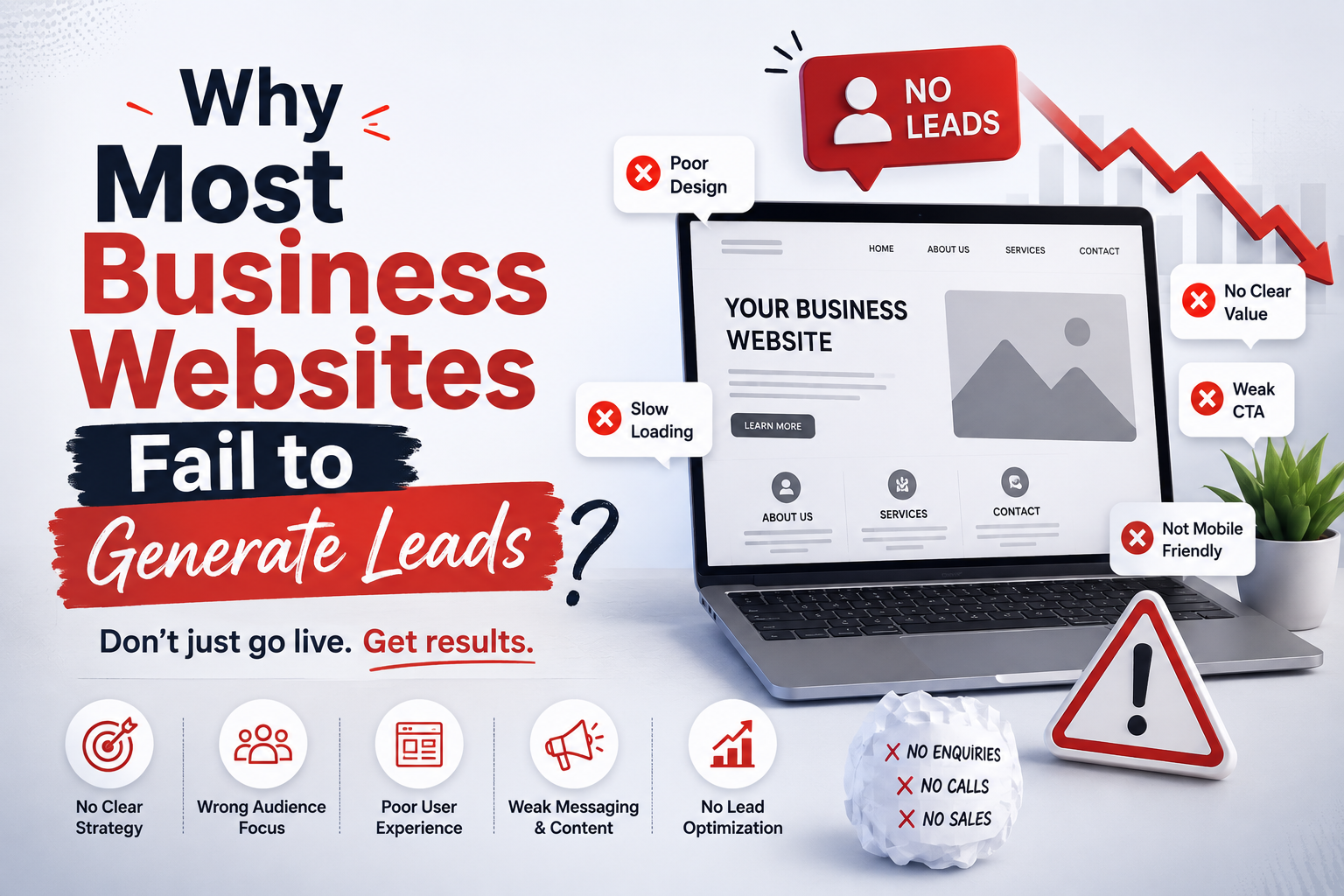
Having a website is almost a basic requirement for any business today. But there is a big difference between having a website and having a website that actually brings in customers.
A business can spend a significant amount of money on design, development, SEO, and advertising and still end up with very few inquiries.
So, what goes wrong?
In many cases, the problem isn't traffic. The website itself simply isn't built around what visitors need or what the business wants them to do.
When someone visits your website, they should be able to understand what you do, who you help, why they should trust you, and what their next step should be without having to figure everything out themselves.
If those things aren't clear, even a great-looking website can struggle to generate leads.
Most Websites Are Built for Design, Not Conversions
Let's be honest. It's easy to get caught up in how a website looks.
Businesses want modern layouts, attractive images, animations, stylish fonts, and a design that looks better than their competitors.
There's nothing wrong with that.
The problem starts when design becomes more important than the customer journey.
A website can look fantastic and still generate almost no inquiries.
That's because most visitors aren't visiting your website to admire the design. They're there because they have a question, a problem, or a need they want to solve.
When someone lands on your website, they are usually trying to figure out a few simple things:
- What does this business actually offer?
- Is this service right for me?
- Can they solve my problem?
- Can I trust this company?
- What should I do if I want to move forward?
If your website doesn't answer those questions quickly, there's a good chance the visitor will leave.
A lead-generating website isn't just about being creative. It needs a sensible structure, clear communication, trust-building elements, and an understanding of what the visitor is actually looking for.
Weak Messaging Creates Confusion
Another common problem is the way businesses communicate on their websites.
Many websites spend too much time talking about the company and not enough time talking about the customer's problem.
You'll often see phrases like:
- "We provide high-quality services."
- "We are industry experts."
- "Customer satisfaction is our top priority."
- "We deliver innovative solutions."
These statements aren't necessarily wrong. They just don't tell the visitor very much.
Almost every business can say the same thing.
Instead, your website messaging should make it obvious:
- Who you help
- What you do
- What problem you solve
- What customers can expect
- Why they should choose you
- What they should do next
For example, instead of saying:
"We provide professional digital marketing services."
You could say:
"We help small businesses attract more qualified customers through SEO, paid advertising, and conversion-focused websites."
The second version gives the visitor much more information in a single sentence. They can immediately understand who the service is for, what you offer, and what you're trying to help them achieve.
Clear messaging also makes it easier for search engines and AI-powered search platforms to understand your business and the topics your website covers.
Poor Call-To-Actions Can Cost You Leads
Sometimes the problem isn't the content or even the traffic.
The visitor is interested. They simply don't know what to do next.
That's where your call-to-action (CTA) comes in.
Some websites make visitors search for the contact page. Others use buttons with vague labels such as:
- Submit
- Click Here
- Send
- Learn More
These buttons don't always give the visitor a clear reason to click.
A stronger CTA tells people what happens next.
For example:
- Get a Free Consultation
- Request a Free Quote
- Book a Strategy Call
- Schedule a Discovery Call
- Start Your Project
- Talk to Our Team
The CTA should also match the visitor's stage in the buying process.
Someone who is still researching your service may be more comfortable clicking "Learn How It Works."
Someone who has already decided they need the service may be more likely to click "Request a Quote."
You don't need a button every few inches.
You simply need to make the next step obvious when the visitor is ready to take it.
Slow Websites and Poor Mobile Experiences Hurt Conversions
Website performance is another area businesses sometimes overlook.
People may find your website through Google, social media, advertisements, referrals, or directly through your business name. Regardless of where they come from, they expect the website to load quickly and work properly.
If the page takes too long to load, the layout breaks, or the website is difficult to use on a phone, many visitors won't stick around.
Poor website performance can affect:
- User experience
- Engagement
- Search visibility
- Trust
- Conversion opportunities
This is particularly important because businesses sometimes spend a lot of money bringing visitors to their website through SEO or paid advertising, only to lose those visitors because the website itself isn't performing well.
More traffic won't solve a conversion problem.
In fact, sending more people to a website that doesn't convert can simply mean spending more money without getting better results.
Your website should be:
- Fast
- Mobile-friendly
- Easy to navigate
- Technically reliable
- Easy to read
- Simple to use
A Website Without a Strategy Rarely Performs Well
A business website shouldn't be treated as an online brochure that you build once and forget about.
It should be part of your overall marketing and sales process.
Before deciding on pages, content, and design, businesses should have a clear understanding of:
- Who their ideal customers are
- What those customers are searching for
- What problems they're trying to solve
- What concerns or objections they may have
- What information they need before making a decision
- What action you want them to take
That information should shape the website.
For example, a service-based business might have a customer journey that looks something like:
Homepage → Service Pages → Case Studies/Proof → FAQ → Contact or Consultation
An e-commerce website will obviously have a different journey.
There isn't one website structure that works for every business. The right structure depends on your audience, your offer, and how your customers make buying decisions.
Why SEO Alone Isn't Enough
SEO is still an important part of digital marketing. But rankings and traffic aren't the same thing as business growth.
Imagine a website receives 10,000 visitors every month but only generates a handful of inquiries.
Would you say the website has a traffic problem?
Probably not.
It may have a conversion problem.
Getting people to your website is only the first part of the process. Once they arrive, your website needs to give them a reason to stay, trust you, and take action.
Today's businesses also need to think beyond traditional search.
Your website and content may be discovered through:
- Traditional search engines
- AI-powered search experiences
- Social platforms
- Referrals
- Direct searches
- Existing customers
That means your content needs to be useful and easy to understand rather than simply written around a list of keywords.
The better approach is to create content that answers the real questions your potential customers are asking.
SEO, AEO, and GEO: What Businesses Should Know
Search is changing quickly.
Traditional SEO (Search Engine Optimization) focuses on improving a website's visibility in search engine results.
AEO (Answer Engine Optimization) is more focused on providing clear, direct answers to questions so information can be understood and surfaced by answer-focused search experiences.
GEO (Generative Engine Optimization) is commonly used to describe efforts to make a brand's information easier for generative AI-powered search systems to understand and potentially surface.
These approaches overlap, but there isn't a magic trick that guarantees your business will appear in AI-generated answers.
The fundamentals still matter.
You need:
- Useful content
- Clear explanations
- Logical website structure
- Accurate information
- Demonstrated expertise
- Brand credibility
- Relevant internal and external references
- Good technical performance
- A strong user experience
The goal shouldn't be to write content purely for algorithms.
The better goal is to create genuinely useful information for your customers and present it in a way that search engines and AI systems can understand.
How to Turn Your Website Into a Lead-Generating Machine
If your website isn't bringing in enough leads, don't immediately assume you need a complete redesign.
Start by looking at the fundamentals.
1. Define Your Ideal Customer
Trying to speak to everyone usually results in messaging that doesn't really connect with anyone.
Be specific about the type of customer you want to attract.
Think about their problems, goals, expectations, concerns, and what ultimately influences their buying decision.
The clearer your audience is, the easier it becomes to create relevant website content.
2. Improve Your Homepage Message
Your homepage should make the basics clear almost immediately.
A simple framework is:
Who you help + What you do + Why it matters + What the visitor should do next
People shouldn't have to scroll through half the website just to figure out what your company actually does.
Make the core message obvious.
3. Create Dedicated Service Pages
If your business offers several services, don't try to explain everything on one generic page.
Create dedicated pages for your main services.
Each page can explain:
- What the service is
- Who it's for
- The problem it solves
- Key benefits
- How the process works
- Frequently asked questions
- What the visitor should do next
It also gives you more opportunities to target specific search intent.
4. Add Real Trust Signals
People are naturally more comfortable contacting a business when they can see evidence that others have had a good experience with it.
Depending on your business, useful trust signals can include:
- Client testimonials
- Case studies
- Reviews
- Certifications
- Relevant industry experience
- Client logos
- Results and examples
- Clear business information
The important part is authenticity.
Don't add impressive-looking claims simply because they sound good. Use genuine customer feedback, real results, and information you can actually support.
5. Improve Your CTAs
Take a look at the main pages on your website and ask yourself:
"If someone is interested after reading this page, do they know exactly what to do next?"
If the answer is no, your CTA probably needs work.
The visitor shouldn't have to figure out how to contact you after you've convinced them that your service could help.
6. Make It Easy to Contact You
Don't make potential customers hunt for your phone number, email address, or contact form.
Depending on your business, you could offer:
- Contact forms
- Phone calls
- Appointment booking
- Consultation requests
The fewer unnecessary steps between interest and contact, the better.
7. Check Your Website on Mobile
Don't rely only on how your website looks on a desktop computer.
Open it on an actual smartphone and use it like a customer would.
Look for problems such as:
- Text that's too small
- Difficult navigation
- Buttons that are hard to tap
- Images that load slowly
- Overlapping elements
- Forms that are unnecessarily long
- Poor spacing
A website that looks great on a large monitor but feels frustrating on a phone still has a problem.
8. Improve Website Speed
Look for things that may be slowing the website down.
Compress large images, remove unnecessary scripts, optimize your code, use appropriate caching, and keep an eye on Core Web Vitals and other performance indicators.
Technical optimization isn't just about search rankings.
A faster website generally creates a better experience for the people you're trying to convert.
9. Create Content Around Customer Questions
One of the easiest ways to make your content more useful is to start with the questions your potential customers are already asking.
For example:
- How much does [service] cost?
- How long does [service] take?
- What's included?
- Is [service] suitable for my business?
- How does the process work?
- What should I look for when choosing a provider?
These aren't just SEO topics.
They're questions people genuinely want answered before spending money.
Answering them honestly can help attract people who are already considering a solution.
10. Track What Actually Generates Leads
Website traffic is useful, but it shouldn't be the only number you watch.
Pay attention to things such as:
- Contact form submissions
- Phone calls
- Appointment bookings
- Quote requests
- Conversion rate
- Landing page performance
- Traffic sources
- Cost per lead
This gives you a much clearer picture of what's actually contributing to business growth.
Your Website Should Be Part of Your Marketing System
One of the biggest mistakes businesses make is treating their website as a one-time project.
The website gets launched, everyone celebrates, and then nobody touches it for the next two or three years.
But your customers, competitors, services, technology, and marketing channels are constantly changing.
Your website should change with them.
Think about the journey as:
Traffic → Landing Page → Content → Trust → CTA → Lead → Follow-up
Every part of that journey matters.
You can have excellent traffic, but if the landing page doesn't make sense, you'll lose people.
You can have a great landing page, but if visitors don't trust the company, they may still leave.
And even if someone trusts you, they may not contact you if there isn't an obvious next step.
Lead generation works best when all of these pieces work together.
How SmarterDigi Builds Lead-Generating Websites
At SmarterDigi, we believe a business website should do more than provide an attractive online presence.
It should support the company's marketing and growth goals.
Our approach focuses on:
- Conversion-focused website structure
- User experience
- Clear messaging
- SEO
- AEO and AI-search-friendly content structure
- Mobile responsiveness
- Website performance
- Lead-generation strategy
- Intent-driven content
- Clear calls-to-action
The goal isn't to create a website that simply fills screen space with information.
The goal is to create a digital experience that helps people understand the business, feel confident about the brand, and take the next step.
Because a website shouldn't just exist online.
It should contribute to your business.
Final Thoughts
Most business websites don't fail because they look bad.
They fail because they don't clearly explain the value they're offering, they don't build enough trust, or they make it difficult for visitors to take the next step.
Good design matters.
But good design on its own doesn't generate leads.
A successful business website brings several things together:
Strategy + Messaging + UX + Performance + SEO + Trust + Conversion
And as search continues to evolve with AI-powered experiences, businesses need to think carefully about the quality of their content as well.
Information should be useful, credible, easy to understand, and based on the questions real customers are asking.
The best websites aren't built only for Google.
They're not built only for AI systems either.
They're built for people first, with strong technical and content foundations that make the business easier for search systems to discover and understand.
When all of those pieces work together, your website becomes more than an online brochure.
It becomes a long-term lead-generation asset for your business.
Frequently Asked Questions
Why is my business website not generating leads?
There can be several reasons. Common problems include unclear messaging, weak CTAs, a poor mobile experience, slow loading times, a lack of trust signals, complicated contact processes, and a website structure that doesn't match what customers are actually looking for.
How can I increase leads from my website?
Start with the basics. Improve your homepage messaging, create focused service pages, use stronger CTAs, add genuine reviews and case studies, improve mobile performance, make contacting you easier, and track which pages and channels are actually generating conversions.
Does website design affect lead generation?
Yes, but design is only one part of the equation. Good design makes it easier for visitors to navigate the website, understand your offer, find important information, and take action. The design should support usability and conversion rather than focus only on appearance.
How important are call-to-actions?
CTAs give visitors a clear idea of what to do next. A well-placed CTA can make it easier for an interested visitor to request a quote, book a consultation, contact your team, or start a purchase.
Is SEO enough to generate leads?
No. SEO can bring relevant visitors to your website, but traffic and rankings don't automatically turn into customers. You also need clear messaging, trust, good UX, strong CTAs, and a straightforward conversion journey.
What is the difference between SEO, AEO, and GEO?
SEO generally focuses on improving visibility in traditional search engines. AEO focuses more on providing clear answers to user questions, while GEO is commonly used to describe efforts to make information easier for generative AI-powered search experiences to understand and use.
How often should a business website be updated?
There isn't a single schedule that works for every business.
Your website should be updated when your services, pricing, branding, customer needs, technology, or business goals change. Analytics and conversion data can also show you which parts of the website need improvement.
What should a lead-generating website include?
A strong lead-generation website will usually include clear messaging, detailed service information, genuine trust signals, testimonials or case studies where available, strong CTAs, easy contact options, mobile-friendly design, good performance, useful content, and analytics for tracking conversions.
The Author
Editorial Team
Our editorial team creates high-quality educational content.