

What Is GEO and Why Indian Businesses Need It
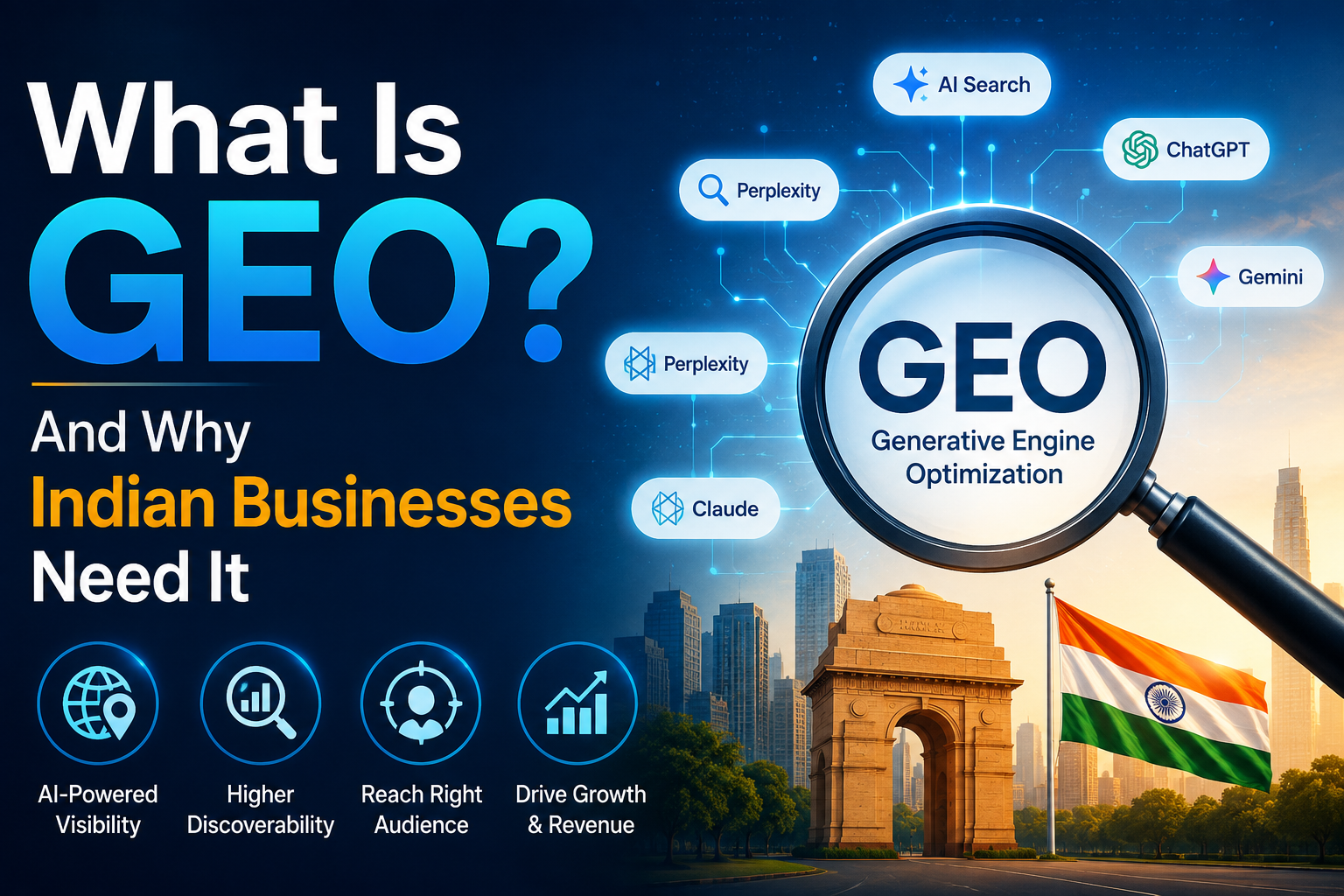
Imagine a small business owner in Delhi searching for a digital marketing agency.
Instead of typing "best digital marketing agency in Delhi for small business" into Google, comparing several websites, opening review pages, and making a shortlist, they ask an AI-powered search tool:
"Which digital marketing agencies in Delhi are suitable for a small business, and what makes each one different?"
The answer may not look like a traditional search results page.
Instead, the system can combine information from multiple sources and produce a conversational answer with links, references, recommendations, or summaries.
That changes an important part of digital marketing.
For years, businesses have focused on getting their websites discovered in search engines. Now, they also have to think about something slightly different:
Can search and AI systems clearly understand who we are, what we offer, where we operate, and why a customer should consider us?
This is where Generative Engine Optimization (GEO) comes in.
GEO is not a replacement for SEO. It is not a secret technique for getting your business into ChatGPT. And it certainly is not a guaranteed shortcut to appearing in Google's AI experiences.
Instead, GEO is a broader approach to making a business, its expertise, and its information easier for AI-powered search and answer systems to understand, evaluate, reference, and surface.
For Indian businesses competing in crowded markets such as Delhi, Mumbai, Bengaluru, Hyderabad, Pune, Chennai, Kolkata, and Ahmedabad, that shift is worth paying attention to.
What Is GEO?
GEO stands for Generative Engine Optimization.
In simple terms, GEO is the practice of improving your business's online presence so that AI-powered search and answer systems can better understand, interpret, and potentially reference your content and brand when answering relevant questions.
Traditional SEO is largely concerned with helping web pages become discoverable and competitive in search engines.
GEO considers a wider question:
When an AI system is generating an answer, does it have enough clear, trustworthy and relevant information to understand your business correctly?
That information can come from many places, including:
- Your website
- Service pages
- About pages
- Author information
- Structured data
- Reviews
- Business profiles
- Industry publications
- Relevant third-party websites
- Local citations
- Digital PR
- Other credible references to your brand
For example, suppose you operate a web development company in Bengaluru.
Your website says that you build websites.
That's a start.
But a much clearer digital presence might explain:
- What types of websites you build
- Which industries you serve
- Where your company operates
- What technologies you use
- What problems you solve
- Who is behind the company
- What your process looks like
- What customers say about your work
- Which services are separate from one another
- What experience your team has
The more consistently this information appears across credible sources, the easier it can be for systems to establish the context around your business.
That does not mean an AI platform will automatically recommend you.
There is no guaranteed GEO ranking position.
AI search systems can change their results depending on the query, available information, location, freshness, sources, and other signals.
So think of GEO as search visibility adapted to an increasingly answer-oriented web, not as a trick for manipulating AI answers.
A Simple Example of GEO
Consider two fictional restaurants in Delhi.
Restaurant A
Its website contains only:
"Welcome to ABC Restaurant. We serve the best food in Delhi."
There is little information about the cuisine, location, menu, specialties, team, customer experience, or the type of diner it serves.
Restaurant B
Its online presence clearly explains:
- It is a North Indian restaurant in South Delhi
- Its menu focuses on traditional Punjabi cuisine
- It serves family dinners and private gatherings
- Its exact location and contact details are consistent
- Customers have left genuine reviews
- Its website contains a detailed menu
- Local publications mention the restaurant
- Its business information is consistent across relevant platforms
Neither restaurant is guaranteed to appear in an AI-generated recommendation.
But Restaurant B has given search systems substantially more context to work with.
That distinction is at the heart of GEO.
GEO vs SEO: What's the Difference?
SEO and GEO overlap heavily, which is why separating them too aggressively can be misleading.
A business still needs a technically sound website, useful content, authority, relevant links and mentions, strong local signals where applicable, and a good user experience.
The difference is mainly where and how that information is consumed.
| Factor | SEO | GEO |
|---|---|---|
Main objective | Improve search visibility and organic discovery | Improve the likelihood that a business or content is understood and surfaced in AI-generated experiences |
Primary environment | Traditional search results and search features | AI-powered answers, conversational search, and generative search experiences |
User behaviour | Keywords, queries, and browsing results | Longer questions, conversations, and follow-up prompts |
Content | Helpful, relevant, and search-friendly | Helpful, clear, contextual, and easy to interpret |
Visibility | Rankings, snippets, and search features | Mentions, citations, links, references, and recommendations |
Brand authority | Important | Important |
Citations and mentions | Useful | Potentially valuable for establishing context and credibility |
Reviews | Important for reputation and local visibility | Can contribute useful third-party context about a business |
Structured data | Helps search engines understand page information | Can contribute to clearer machine-readable business information |
Long-term strategy | Technical SEO + content + authority + experience | Strong SEO foundation + entity clarity + reputation + content + broader AI-search readiness |
The biggest mistake would be treating these as two completely separate marketing disciplines.
Good GEO work often starts with good SEO.
If your website is confusing to humans, it is unlikely that adding a few FAQ sections and schema tags will suddenly make your business exceptionally understandable to AI systems.
Why GEO Matters in 2026
Search is becoming increasingly conversational.
People can ask complete questions instead of constructing short keyword combinations.
Compare:
Traditional query:
"digital marketing agency Delhi"
with:
Conversational query:
"I'm a small business in Delhi with a limited marketing budget. What type of digital marketing agency should I hire, and what should I look for?"
The second question requires more than matching a keyword.
The system has to understand:
- The user's location
- The type of business
- The user's objective
- Their constraints
- The services being discussed
- Potential alternatives
- Relevant sources
AI-powered search experiences can also combine information from different pages and sources instead of simply presenting a list of links.
This creates a new visibility opportunity.
But it also creates a new problem.
A company can no longer assume that ranking for one keyword is the entire visibility strategy.
A customer might discover a business through a conventional search result, a local result, a review, an AI-generated answer, a comparison article, a publication, or a recommendation generated from several sources.
That is why businesses should think about digital visibility as a whole.
Why Indian Businesses Need GEO
India is an unusually competitive digital market.
A local business in Delhi may compete with dozens of agencies, consultants, restaurants, clinics, real estate companies or service providers targeting similar customers.
A SaaS startup in Bengaluru can compete globally.
An IT company in Hyderabad may sell to customers in the United States.
A hotel in Mumbai may depend on travelers researching accommodation before they ever visit the city.
The opportunity is not limited to one type of business.
1. Digital Marketing Agencies
Imagine someone asks:
"Which digital marketing agencies in Delhi work with small businesses?"
An agency's website should make it easy to understand:
- What services it provides
- Which businesses it serves
- Where it operates
- What its areas of expertise are
- Who the team members are
- What experience it has
- How customers can contact it
A generic homepage saying "We provide result-driven digital marketing solutions" provides very little useful context.
Specific information is more valuable.
2. Restaurants and Hotels
Local businesses have another advantage: location is part of the entity.
A restaurant in Mumbai should make its identity, address, cuisine, opening information, menu, services, and customer experience clear.
A hotel in Jaipur may want its website to clearly communicate:
- Location
- Property type
- Room categories
- Facilities
- Nearby attractions
- Dining options
- Booking information
- Guest policies
Local SEO and GEO therefore overlap significantly.
3. Real Estate Companies
Real estate searches are highly contextual.
Someone might ask:
"What are good areas in Pune for buying a two-bedroom apartment for a family?"
A real estate business that publishes genuinely useful information about neighborhoods, property types, buying considerations, locality comparisons and market terminology creates a much stronger information footprint than one that only publishes property listings.
The goal isn't to manufacture AI recommendations.
The goal is to become a credible source of information within your subject area.
4. SaaS and IT Companies
Indian SaaS and technology companies often serve customers outside India.
For them, GEO can become part of a broader international search strategy.
Useful content can include:
- Product comparisons
- Technical guides
- Implementation documentation
- Industry use cases
- Integration guides
- FAQs
- Original research
- Product explainers
- Troubleshooting resources
The more clearly a company explains what its product does and whom it serves, the easier it becomes for users and systems to understand its positioning.
5. Consultants and Professional Services
A consultant should not simply claim:
"We are India's leading business consultant."
Instead, explain:
- What problems you solve
- Who you work with
- What your methodology involves
- What areas you specialize in
- What credentials or experience are relevant
- What clients can realistically expect
- Which situations are outside your expertise
Clear positioning beats vague superlatives.
GEO for Local Indian Businesses
For local businesses, GEO should begin with local SEO fundamentals, not replace them.
Make sure your digital presence consistently communicates:
Google Business Profile
Keep your business name, category, address, phone number, website, services and other relevant information accurate and up to date.
Reviews
Genuine customer reviews can provide valuable third-party context about the customer experience.
Do not buy or manufacture reviews.
NAP Consistency
Your Name, Address and Phone number should be consistent wherever the business is legitimately listed.
Location Pages
If you genuinely serve multiple locations, create useful location pages that explain the services available there.
Do not create dozens of nearly identical city pages simply to capture keywords.
Service Pages
Each major service should have its own clear page when it deserves one.
Local Content
Answer questions customers actually ask.
For example:
- How much does home painting cost in Delhi?
- What should I check before hiring a wedding photographer in Mumbai?
- How long does AC installation take in Pune?
- What documents are needed to sell a property in Bengaluru?
Useful local information can establish relevance far better than stuffing a city name into every paragraph.
First-Party Business Information
Your own website should be the clearest source of truth about your business.
Make it easy to understand what you do, where you operate, who you serve and how customers can reach you.
How AI Search Understands a Business
We should be careful here.
Nobody outside an AI company's engineering and ranking teams can honestly claim to know a universal list of "GEO ranking factors."
Different systems work differently.
AI systems can use multiple sources and signals to produce an answer, and the information available to them can change over time.
A useful way to think about the process is through context.
Entity
An entity is essentially the identifiable thing being discussed.
Your company is an entity.
Your founder is a person.
Your Delhi office is a location.
Your service is a concept or offering.
Your product is another identifiable thing.
The clearer the relationship between these pieces of information, the less ambiguity there is.
Context
"ABC" by itself tells us very little.
"ABC Digital is a digital marketing agency serving small businesses in Delhi" provides considerably more context.
Topical Relevance
If your website consistently demonstrates expertise in SEO, website development and digital marketing, your content creates a stronger topical association around those subjects.
That does not mean publishing 500 nearly identical articles.
It means building useful depth around the topics that actually matter to your customers.
Brand Mentions
A brand mentioned by relevant, credible third-party sources can have a stronger digital footprint than a brand that exists only on its own website.
The quality and relevance of those references matter more than simply collecting as many mentions as possible.
Reputation
Reviews, editorial coverage, industry references and customer experiences can all contribute to how a business is perceived online.
Structured Information
Structured data can help search engines understand certain types of information about a page or organization when implemented correctly.
But schema markup is not a magic GEO switch.
It should accurately describe visible, relevant information rather than being used to make unsupported claims.
How to Optimize Your Website for GEO
There is no single "GEO optimization checklist" that guarantees AI visibility.
However, there are several practical improvements that make your digital presence clearer and more useful.
1. Build Clear Topical Authority
Don't publish random articles simply because they contain keywords.
Build meaningful coverage around the problems your customers care about.
A roofing company, for example, could cover roof maintenance, repair costs, materials, common problems, installation considerations and local weather-related concerns.
The goal is depth, not volume.
2. Create Useful, Original Content
Your content should give the reader something they can actually use.
Avoid rewriting the same information already available on dozens of websites.
Add:
- Original observations
- First-hand experience
- Expert explanations
- Examples
- Comparisons
- Data you have genuinely collected
- Practical frameworks
3. Answer Specific Customer Questions
Questions are an excellent way to discover what information your website is missing.
Instead of writing:
"Digital Marketing Services"
also answer:
"How much should a small business spend on digital marketing?"
"Should a local business invest in SEO or Google Ads first?"
"How long does local SEO usually take?"
Specific questions create useful entry points for both searchers and conversational systems.
4. Strengthen Your About Page
Your About page should not be an afterthought.
Explain:
- Who the company is
- What it does
- Who founded it
- Where it operates
- What it specializes in
- Relevant experience
- Industry focus
- Contact information
For expert-led content, accurate authorship and information about who created the content can also help establish transparency and trust.
5. Make Services Clearly Understandable
Avoid putting every service on one enormous page.
If you provide:
- SEO
- Website design
- Google Ads
- Social media marketing
- Content marketing
consider creating clear service pages where appropriate.
Explain what each service includes, who it is for, what problems it solves and what the process looks like.
6. Use Structured Data Correctly
Use appropriate structured data when it genuinely describes the page.
For example, depending on the business and page:
- Organization
- LocalBusiness
- Article
- Product
- BreadcrumbList
- FAQ-related markup where applicable
Don't add schema simply because someone says "more schema equals better GEO."
Accuracy matters more than markup volume.
7. Strengthen Local SEO
For Indian businesses serving specific locations, local SEO remains essential.
Keep your website, business profile, contact information, service areas and legitimate citations consistent.
GEO should complement local SEO rather than replace it.
8. Earn Genuine Mentions
A business mentioned by relevant industry websites, publications, associations and other credible sources can develop a stronger online reputation.
Focus on earning mentions.
Do not turn GEO into a new excuse for spammy link-building.
9. Build a Strong Review Profile
Ask genuine customers for honest reviews.
Respond professionally.
Don't write fake testimonials.
Don't buy reviews.
Don't ask customers to make claims they did not experience.
A real reputation is more valuable than a large collection of suspicious five-star ratings.
10. Keep Business Information Consistent
If your website says one thing, your business profile says another, and a directory lists an old address, you've created unnecessary ambiguity.
Review important business information periodically.
11. Demonstrate Experience and Expertise
Don't just say:
"We are experts in SEO."
Show it.
Publish useful analysis.
Explain real processes.
Identify limitations.
Use author bios.
Document genuine projects where appropriate.
Demonstrate how your knowledge was developed.
12. Keep Content Updated
A three-year-old article about a rapidly changing technology may no longer be accurate.
Review important pages.
Update outdated information.
Remove claims that are no longer true.
13. Create Comparison and Decision-Making Content
Customers rarely ask only informational questions.
They also ask:
- SEO vs Google Ads: which is better?
- Shopify vs WooCommerce: which is suitable for a small business?
- In-house marketing vs agency?
- Which hotel area is best for a family?
- Which CRM is suitable for a startup?
Decision-making content can be extremely useful when it is balanced and genuinely informative.
14. Publish Original Insights and Data
If your business has access to legitimate first-party data, use it.
For example:
"We analyzed 200 support requests from local service businesses and found five recurring website problems."
That is far more distinctive than another generic article titled "10 Benefits of Digital Marketing."
Content Types That Can Help GEO
Different businesses need different content.
| Content Type | Best For | Example |
|---|---|---|
FAQs | Almost every business | "How long does SEO take?" |
Service pages | Agencies and service businesses | "Local SEO Services in Delhi" |
Location pages | Local businesses | "Web Design Services in Pune" |
Comparisons | SaaS, agencies, ecommerce | "SEO vs Google Ads" |
How-to guides | Technical and professional businesses | "How to Set Up Google Business Profile" |
Expert articles | Consultants and agencies | "How Small Businesses Should Approach SEO" |
Case studies | Service businesses and SaaS | "How We Improved Organic Visibility" |
Original research | Established brands | "Local Search Trends Report" |
Glossaries | Technical industries | "What Is Conversion Rate Optimization?" |
Product explainers | SaaS and ecommerce | "How Our CRM Automation Works" |
Industry guides | B2B companies | "Digital Marketing Guide for Indian Startups" |
The important point is not to create every content type.
Create the formats that answer the questions your customers actually have.
GEO and E-E-A-T
GEO and E-E-A-T are related conceptually, but they are not the same thing.
Google describes E-E-A-T through:
- Experience
- Expertise
- Authoritativeness
- Trustworthiness
It is important not to turn this into another misleading SEO formula.
E-E-A-T is not a magic "GEO ranking factor."
Instead, think about what these concepts encourage you to do:
Show who created the information.
Demonstrate relevant knowledge.
Use trustworthy sources.
Be transparent about experience.
Avoid unsupported claims.
Make the business identity clear.
For example, a medical clinic should not publish an anonymous article making broad medical claims without qualified authorship and credible sourcing.
Similarly, a financial company should not create generic investment content simply to capture keywords.
The higher the consequences of bad information, the more important credibility becomes.
GEO Mistakes Businesses Should Avoid
1. Keyword Stuffing
Repeating "best SEO company Delhi" 40 times doesn't make a page more authoritative.
Write naturally.
2. Publishing Generic AI Content
Using AI to assist with research or drafting is not the same as publishing hundreds of unedited, generic pages.
Content still needs value.
3. Creating Hundreds of Low-Quality Pages
A website with 500 thin city pages is not automatically stronger than one with 20 excellent pages.
4. Fake Reviews
Never manufacture customer experiences.
5. Fake Expertise
Don't create fake author profiles or pretend someone has experience they don't have.
6. Manipulative Backlinks
GEO isn't a reason to start buying thousands of links.
7. Copying Competitors
If every agency writes the same article, publishing another version of it adds little value.
8. Unsupported Claims
Avoid statements such as:
"We are the #1 agency recommended by AI."
Unless you can substantiate a claim, don't make it.
9. Ignoring Local SEO
A local business cannot expect an AI-search strategy to compensate for poor basic business information.
10. Ignoring Brand Reputation
Your website is only one part of your online identity.
11. Inconsistent Business Information
Conflicting addresses, phone numbers, service descriptions or company names create unnecessary confusion.
12. Writing Only for Search Engines
If a page reads like it was created for an algorithm rather than a person, rethink the page.
13. Expecting Immediate AI Visibility
AI search visibility is dynamic.
There is no sensible promise that publishing an article today means an AI system will mention the company tomorrow.
14. Assuming GEO Replaces SEO
This is perhaps the biggest mistake.
It doesn't.
Does GEO Replace SEO?
No.
SEO remains foundational.
A useful way to think about the relationship is:
SEO helps build search visibility and discoverability.
GEO focuses on making your business and content easier to understand and potentially surface within AI-generated search and answer experiences.
The two strategies overlap because both depend heavily on useful content, accessible websites, relevance, authority, trust and clear information.
If your website has technical problems, poor content, weak business information and no authority, calling the strategy "GEO" doesn't solve those problems.
Start with the fundamentals.
Then expand your strategy for the way people increasingly discover information.
A Practical GEO Strategy for an Indian Business
You don't need to rebuild your entire marketing strategy overnight.
A phased approach is more sensible.
Phase 1 - Foundation
Start with:
- Technical SEO
- Mobile-friendly website
- Clear navigation
- Strong website structure
- Accurate business information
- Local SEO where relevant
- Google Business Profile
- Clear service pages
- Strong About page
The objective is simple:
Make the business easy to understand.
Phase 2 - Authority
Next, strengthen your reputation.
Focus on:
- High-quality content
- Expert contributions
- Genuine reviews
- Relevant digital PR
- Industry mentions
- Credible backlinks
- Author profiles
- Original insights
The objective is:
Give people and platforms more reasons to trust the information associated with your business.
Phase 3 - AI Search Readiness
Now expand the content strategy.
Create:
- Question-based content
- Comparison pages
- Detailed service explanations
- Location content
- Helpful FAQs
- Clear entity information
- Appropriate structured data
- Original research
- Industry guides
If your website already has strong SEO fundamentals, much of this work is an extension of what you should have been doing anyway.
Phase 4 - Measurement
GEO measurement is still evolving.
Don't rely on one screenshot of an AI answer as your entire reporting system.
Instead, monitor broader indicators such as:
- Organic search traffic
- Search impressions
- Branded searches
- Referral traffic
- Leads
- Qualified enquiries
- Local visibility
- Review growth
- Brand mentions
- Referral sources
- AI-driven referral traffic where identifiable
Measurement will continue to evolve as AI search becomes more integrated into how people find information.
GEO Checklist for Indian Businesses
Use this as a practical starting point.
- [ ] Website clearly explains what the company does
- [ ] Main services have clear descriptions
- [ ] Target locations are clearly stated where relevant
- [ ] About page explains the company and team
- [ ] Author information is provided where appropriate
- [ ] Contact information is easy to find
- [ ] Business information is consistent across important platforms
- [ ] Google Business Profile is complete and accurate
- [ ] Business has genuine customer reviews
- [ ] Website contains useful FAQ content
- [ ] Content answers real customer questions
- [ ] Website has strong technical SEO fundamentals
- [ ] Appropriate structured data is implemented
- [ ] Important pages are crawlable
- [ ] Relevant third-party websites mention the business
- [ ] Content demonstrates genuine expertise
- [ ] Important claims can be supported
- [ ] Location pages provide genuine local value
- [ ] Service pages explain what customers actually receive
- [ ] Content is reviewed and updated
- [ ] Comparison and decision-making content exists where useful
- [ ] SEO and GEO are treated as complementary strategies
SEO vs AEO vs GEO
These terms are often used interchangeably, which creates unnecessary confusion.
SEO - Search Engine Optimization
SEO traditionally focuses on improving a website's visibility in search engines.
That includes technical optimization, content, links, relevance, usability, local search and many other aspects of organic discovery.
AEO - Answer Engine Optimization
AEO generally focuses on optimizing content so it can answer questions directly in answer-oriented search experiences.
Featured snippets, direct answers and conversational search are often discussed in this context.
GEO - Generative Engine Optimization
GEO generally refers to optimizing a brand's information and content for AI-generated answers and generative search experiences.
The terminology is still evolving.
Different marketers use AEO and GEO slightly differently, and the boundaries are not universally standardized.
That's why I wouldn't spend too much time arguing about the labels.
The more useful question is:
Is your business easy for people, search engines and AI-powered systems to understand and trust?
If the answer is yes, you're moving in the right direction regardless of which acronym you use.
Frequently Asked Questions About GEO
What is GEO in SEO?
GEO stands for Generative Engine Optimization. It refers to practices aimed at improving how clearly a business and its content can be understood, referenced, cited or surfaced in AI-powered search and answer experiences. GEO overlaps significantly with SEO but focuses more explicitly on generative and conversational discovery.
What does Generative Engine Optimization mean?
Generative Engine Optimization means creating and organizing trustworthy, useful and clearly structured information so AI-powered systems have better context when generating answers about relevant topics, businesses, products or services.
Is GEO replacing SEO?
No. SEO remains important. GEO builds on many SEO fundamentals, including crawlability, useful content, authority, relevance, structured information and strong user experience.
Why is GEO important for Indian businesses?
Indian businesses increasingly compete for attention across search engines, social platforms, marketplaces, review sites and AI-powered search experiences. GEO gives businesses a framework for thinking about how clearly their brand and expertise are represented across this wider digital ecosystem.
How can my business appear in AI search results?
There is no guaranteed method for getting an AI system to mention your business. However, you can improve your overall digital visibility by maintaining a crawlable website, publishing useful content, building a credible reputation, keeping business information consistent and earning relevant third-party references.
Does Google AI change SEO?
AI-powered search experiences change how information may be presented, but they do not make SEO irrelevant. Businesses still need discoverable, useful, technically sound websites and trustworthy content. The practical response is to expand your search strategy rather than abandon SEO.
Does local SEO help GEO?
Local SEO can support GEO because local businesses need clear information about their identity, services, location, reputation and customer experience. Local SEO and GEO should generally be treated as complementary.
How long does GEO take to work?
There is no universal GEO timeline. AI visibility depends on the platform, query, sources, crawlability, relevance, authority, freshness and other factors. Businesses should treat GEO as a long-term digital visibility strategy rather than an immediate campaign.
Can small businesses benefit from GEO?
Yes. Small businesses can benefit from making their expertise, services, locations, customer experience and business information clearer online. Smaller businesses can sometimes compete effectively by building strong expertise around a specific niche rather than trying to cover everything.
How much does GEO cost?
There is no fixed GEO price. The cost depends on what needs to be improved. A business may need technical SEO work, content creation, local SEO, digital PR, reputation management, structured data or a complete website improvement.
What is the difference between GEO and AEO?
AEO generally focuses on optimizing content for direct answers and answer-oriented search. GEO is more commonly used for optimizing visibility in generative AI experiences. The terminology overlaps, and different professionals use the terms differently.
Do I need GEO if my website already ranks on Google?
You should not abandon what is already working. If your website has strong organic visibility, that is a useful foundation. GEO can extend the strategy by making your business information, expertise and content clearer for AI-powered discovery.
The Future of Search Is Not Just About Rankings
For a long time, the question was:
"Where does my website rank?"
That question still matters.
But another question is becoming increasingly useful:
"How does my business appear when someone asks an AI system for help?"
Those are not identical questions.
A business can have a strong website and still have a confusing brand footprint.
It can have excellent services but weak third-party recognition.
It can have useful expertise that is buried inside poorly structured pages.
It can rank for keywords while failing to clearly explain what makes it different.
GEO encourages businesses to solve those problems.
And that is why the concept is more useful when treated as a business clarity and digital authority strategy, rather than another SEO trick.
Final Thoughts: Should Indian Businesses Invest in GEO?
Yes - but not by abandoning SEO.
The better approach is to build a digital presence that works across multiple forms of discovery.
Your website should be:
- Search-friendly
- User-friendly
- Trustworthy
- Authoritative
- Well structured
- Locally relevant where appropriate
- Clear about the business and its services
- Supported by genuine reputation
- Easy for both humans and machines to understand
If you're a small business in Delhi, a SaaS company in Bengaluru, a hotel in Mumbai, an IT company in Hyderabad, a consultant in Pune or an ecommerce brand serving customers across India, the underlying principle is the same.
Make your business easy to understand.
Explain what you do.
Show who you help.
Demonstrate what you know.
Keep your information accurate.
Build a genuine reputation.
Create content that answers real questions.
Earn legitimate mentions.
And keep your SEO fundamentals strong.
AI search will continue to change. The specific platforms, interfaces and ways information is presented will change with it.
But businesses that invest in useful content, strong websites, real expertise and trustworthy digital identities will be better positioned for whatever comes next.
Need Help Preparing Your Business for AI Search?
GEO shouldn't be treated as a promise that your business will suddenly appear in ChatGPT or another AI platform.
It should be part of a broader strategy for building stronger search visibility, better content and a more trustworthy online presence.
At SmarterDigi, we help businesses improve their online visibility through:
- SEO
- Website design and development
- Digital marketing
- Content strategy
- Local SEO
- AI-search readiness
If your website is difficult to understand, your services are unclear, or your current SEO strategy isn't bringing the visibility you expect, the first step is usually not another tool or another acronym.
It's getting the fundamentals right.
The Author
Meraj Ahmad
Founder, developer, and SEO strategist with 10+ years of experience building websites and digital solutions. Worked with brands like Short Story Lovers, The Muthoot Group, and IFFCO.